Vascular Laser Treatment in Sarnia
Red lines on the nose, a blue bump on the lip, or bright red dots on the skin are usually small blood vessels close to the surface. A vascular laser can fade them with little downtime.
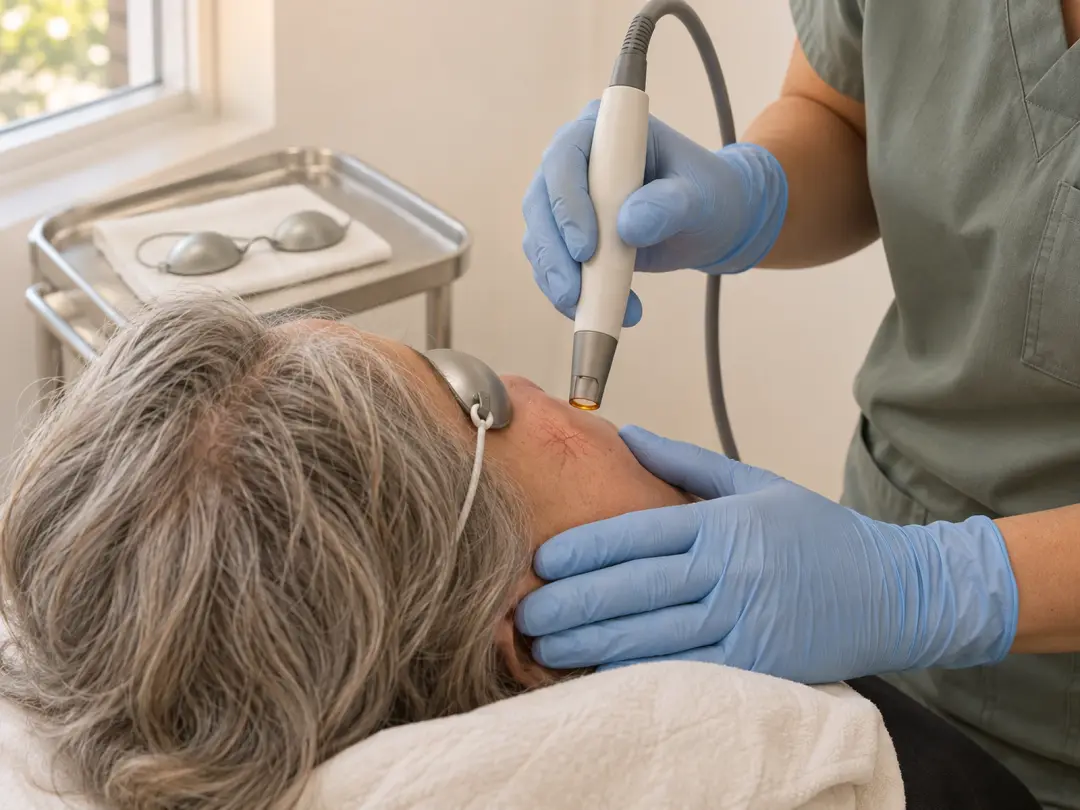
At a glance
No referral needed.
Dr. David Bastien offers vascular laser treatment at 1692 Murphy Rd, Sarnia, for patients across Sarnia and Lambton County.
- Treats broken facial veins, rosacea redness, venous lakes and cherry angiomas
- Every spot is checked by a physician before treatment
- Most visits take 15 to 30 minutes
- Little or no downtime for most patients
What is vascular laser treatment?
A vascular laser sends light that is absorbed by the red colour (haemoglobin) in blood. The heat closes the small vessel, and the body clears it away over the next few weeks.
The skin around the vessel is largely spared. That is why the treatment is precise and usually heals quickly.
At our clinic, treatment uses a 577 nm yellow laser for fine surface vessels and red spots, and a longer-wavelength setting for deeper or larger vessels.
Yellow laser
Wavelength: 577 nm. Best suited to: Fine facial veins, rosacea redness, cherry angiomas.
Pulsed dye laser
Wavelength: 595 nm. Best suited to: Facial redness, red birthmarks, red scars.
Nd:YAG laser
Wavelength: 1064 nm. Best suited to: Deeper vessels, venous lakes, some leg veins.
IPL (not a laser)
Wavelength: broad light. Best suited to: General redness and sun damage over larger areas.
IPL uses a broad band of light, while a vascular laser uses a single wavelength aimed at blood vessels. Lasers are usually more precise for individual vessels.
Vascular Laser Treatment: specific treatments
- Rosacea Laser TreatmentLaser treatment that fades persistent rosacea redness and visible vessels on the face, usually over 3 to 4 sessions.
- Hemangioma Laser TreatmentLaser removal of cherry angiomas, the small bright red spots on the body, often in one short visit.
- Venous Lake Laser TreatmentLaser treatment for venous lakes, the soft blue-purple bumps on the lip, face or ears.
Conditions we treat
Broken capillaries (telangiectasia)
What it looks like: Thin red or purple lines, often on the nose and cheeks. Typical sessions: 1 to 3.
Telangiectatic rosacea
What it looks like: Ongoing redness and visible vessels across the central face. Typical sessions: 3 to 4.
Venous lake
What it looks like: Soft blue or purple bump, often on the lip or ear. Typical sessions: 1 to 2.
Cherry angioma (cherry hemangioma)
What it looks like: Small bright red dot or bump. Typical sessions: 1.
Spider angioma
What it looks like: Red dot with fine "legs" spreading out. Typical sessions: 1 to 2.
Infantile hemangiomas in babies need a different approach. We refer babies and young children to a paediatric dermatology service.
Leg veins: small spider veins on the legs can sometimes be treated. Varicose veins (large, bulging veins) need a vein specialist, and we can refer you.
What causes visible blood vessels?
Most visible vessels on the face come from years of sun, ageing skin, genetics and rosacea. They are common and usually harmless.
- Sun damage weakens the skin's support around small vessels
- Rosacea causes flushing and, over time, visible vessels
- Age and genetics play a big role in cherry angiomas
- Strain, such as heavy coughing or vomiting, can burst tiny vessels around the eyes; these usually fade on their own within 1 to 2 weeks
No vitamin deficiency is a common cause of broken capillaries. A new spot that bleeds, grows quickly or looks different should be checked by a doctor.
Telangiectatic rosacea and laser
Rosacea is a long-term skin condition that affects over three million Canadians. It most often affects the cheeks, nose, chin and forehead.
There is no cure, but rosacea can be managed. A vascular laser treats the visible vessels and persistent redness, while creams and trigger control manage flare-ups.
Vascular laser
Visible vessels and persistent redness.
Prescription creams or pills
Bumps, pimples and flare-ups.
Trigger control
Fewer flare-ups (sun, heat, alcohol, spicy food, stress).
Gentle skin care and daily sunscreen
Less irritation and redness.
Most people get the best result by combining laser with medical treatment. Redness can return over time, so a top-up session may be needed.
How the treatment works
- 1
Consultation
Dr. Bastien examines the spots and confirms they are blood vessels, not something that needs a biopsy.
- 2
Plan
We agree on the areas, the number of sessions and the cost.
- 3
Protection
You wear eye shields, and the skin is cooled.
- 4
Laser
Short pulses are applied to each vessel. Most areas take 10 to 20 minutes.
- 5
Aftercare
A soothing cream and sunscreen are applied before you leave.
Most people feel a quick snap, like a rubber band flicking the skin. Cooling keeps it comfortable, and numbing cream is rarely needed.
Sessions are spaced about 4 weeks apart when more than one is needed.
Not sure this is the right treatment?
Every spot is assessed before anything is treated. If another option suits you better, Dr. Bastien will tell you.
Preparing for your visit
- Avoid tanning and strong sun for 4 weeks before treatment
- Stop self-tanner 2 weeks before
- Come with clean skin and no makeup on the area
- Tell us about blood thinners, isotretinoin and any medication that makes skin light-sensitive
- Tell us if you get cold sores and the lip area is being treated
Treatment is not done during pregnancy, on tanned skin, or over an active skin infection.
Recovery and aftercare
Most people return to normal activities the same day. What you see afterwards depends on the area and the setting used.
- 1
First few hours
Redness and mild warmth, like a sunburn
- 2
Days 1 to 3
Mild swelling, more around the eyes and nose
- 3
Days 1 to 10
Treated vessels may look darker or bruised before fading
- 4
Weeks 2 to 6
Vessels continue to fade as the body clears them
Aftercare tips
- Apply a cool compress for swelling, and sleep with your head raised the first night
- Avoid alcohol, hot showers, saunas and hard exercise for 48 hours
- Wear broad-spectrum SPF 30 or higher every day
- You can wear makeup the next day if the skin is not broken
- Do not scratch or pick the treated area
Call us if you notice blisters, crusting that spreads, or signs of infection.
Results, side effects and risks
Most patients see a clear reduction in the treated vessels within 2 to 6 weeks. Results vary, and some vessels need more than one session.
Treated vessels usually do not return. New vessels can still form over time, especially with sun exposure or rosacea.
| How common | Possible effects |
|---|---|
| Common | Redness, swelling, temporary darkening or bruising |
| Less common | Blistering, crusting, bleeding (venous lakes) |
| Rare | Lighter or darker skin patches, scarring |
Darker skin types have a higher risk of pigment change, so settings are adjusted or another treatment may be advised.
Cost and OHIP coverage
Vascular laser treatment is usually considered cosmetic, so it is not covered by OHIP. Some private plans cover part of the cost when there is a medical reason.
Frequently asked questions
Does vascular laser treatment work?
Yes, for most people. Vascular lasers reliably fade broken capillaries, cherry angiomas and venous lakes, and reduce rosacea redness. Results vary, and some areas need more than one session.
Does vascular laser treatment hurt?
Most people describe a quick snap like a rubber band. Skin cooling makes it comfortable, and the treatment is usually over in minutes.
Is vascular laser treatment covered by OHIP or insurance?
OHIP does not cover cosmetic vascular laser treatment. Some private plans cover part of it, so check with your insurer and ask us for a receipt.
How many sessions of vascular laser do you need?
Small red spots and cherry angiomas often need 1 session. Broken capillaries need 1 to 3, and rosacea redness usually needs 3 to 4, spaced about 4 weeks apart.
How long do the results last?
Treated vessels usually do not come back. New ones can form with age, sun and rosacea, so some people return for a top-up every year or two.
Can laser cure rosacea?
No. Laser reduces the visible vessels and persistent redness, but rosacea itself is long-term. Combining laser with medical treatment and trigger control gives the best control.
Is vascular laser treatment safe?
When a physician checks the skin first and the settings suit your skin type, side effects are usually mild and short-lived. Rare risks include blistering, pigment change and scarring.
Serving Sarnia and Lambton County
Our clinic is at 1692 Murphy Rd, Sarnia, with free on-site parking. We welcome patients from Sarnia, Point Edward, Bright's Grove, Corunna, Petrolia, Forest and across Lambton County.
Book a laser consultation. Call the clinic or book online. Hours: Monday to Friday, 8:30 am to 4:30 pm.
Related: Skin cancer assessment · Photodynamic therapy
Book a consultation
You don’t need a referral. Dr. Bastien examines the area first and tells you whether you need treatment.
1692 Murphy Rd, Sarnia
Monday to Friday, 8:30 am to 4:30 pm
Free parking on site