Skin Tag Removal in Sarnia
A skin tag is a small, soft, harmless flap of skin that hangs from a thin stalk. Most never need treatment, but many people choose removal when a tag catches on clothing, gets irritated or simply bothers them.
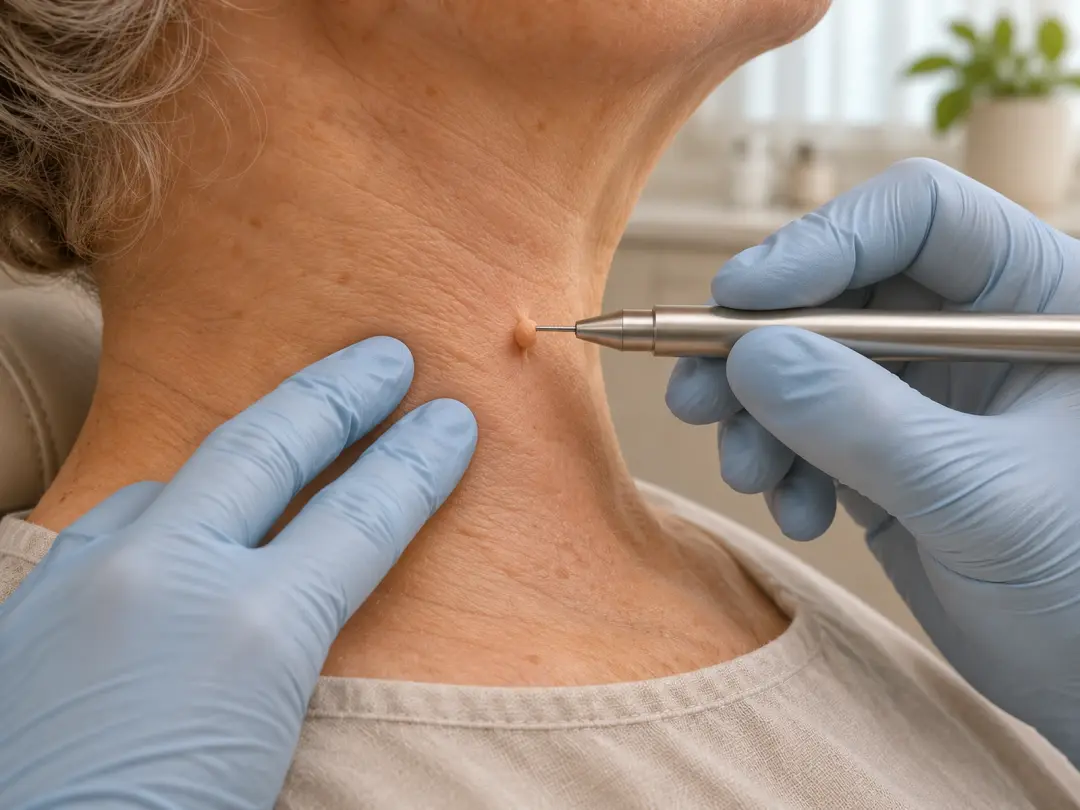
At a glance
- Healing
- About 1 to 2 weeks
- Anaesthetic
- Local anaesthetic
- OHIP
- Private fee
Usually not, when removal is for appearance
No referral needed.
Here is what to know before deciding: how to tell a skin tag from other growths, how removal works, what healing is like and what it costs in Sarnia.
Harmless
Skin tags are not cancer, but a growth should be checked before it is removed
Usually optional
Removal is mostly for comfort or appearance
Quick
Snipping, freezing or heat, usually done in a few minutes
Quick answers
Are skin tags dangerous?
No. They are benign growths of normal skin.
Do they go away on their own?
Rarely. Most stay unless removed.
How are they removed?
Snipping, freezing, heat (cautery) or laser
Does it hurt?
Brief. Larger tags are numbed first.
How long to heal?
About 1 to 2 weeks
Does OHIP cover it?
Usually not, when removal is for appearance
What is a skin tag?
A skin tag (medical name: acrochordon) is a small outgrowth of normal skin. Inside is a core of loose collagen fibres and tiny blood vessels, covered by an ordinary layer of skin.
Tags range from about 1 mm to 1 cm or more. They can look like a tiny bump or a longer, narrow flap attached by a stalk.
Feel
Soft and movable.
Colour
Skin-coloured or slightly darker.
Shape
Hangs from a thin stalk.
Common areas
Neck, underarms, eyelids, groin, under the breasts, skin folds.
Number
One, a few, or many.
Contagious?
No.
What causes skin tags?
The exact cause is not known. They are very common and become more common with age.
They tend to form where skin rubs against skin or clothing. Things often linked with them include:
- Friction: in skin folds such as the neck, armpits and groin
- Age: more common from middle age onward
- Body weight: more common with higher body weight
- Hormones: often appear during pregnancy, and many fade after the baby is born
- Blood sugar: more common in people with insulin resistance or type 2 diabetes
- Family history: they often run in families
If you suddenly develop many skin tags, mention it to your family doctor. They may want to check things like your blood sugar.
Is it a skin tag or something that needs medical attention?
Most soft, hanging growths in skin folds are skin tags. But some other growths can look similar, so it is worth having one checked before it is removed.
Mole (raised)
Usually firmer, often brown, sits on a wider base.
Seborrheic keratosis
Waxy or warty, looks "stuck on" rather than hanging.
Wart
Rough surface, caused by a virus, can spread.
Neurofibroma
Soft bump that can press inward, sometimes in larger numbers.
Genital wart
In the genital or anal area. Needs medical assessment, not cosmetic removal.
Skin cancer
Rarely, can look like a tag. Grows, bleeds or changes.
Have a growth checked if it
- Bleeds without being caught or injured
- Grows quickly or changes colour, shape or texture
- Is dark, has several colours, or has a firm base
- Is sore, crusted, or does not heal
- Is in the genital or anal area
- Looks different from your other skin tags
A clinician can usually tell a skin tag just by looking. If anything is unusual, the removed tissue can be sent to a lab for testing.
For spots that are changing, see our skin cancer assessment page.
Do skin tags need to be removed?
No, not for health reasons. Skin tags are harmless, so removal is a personal choice.
People usually choose removal when a tag:
- Catches on necklaces, collars, bra straps or a seatbelt
- Gets nicked when shaving
- Becomes red, sore or bleeds after rubbing
- Bothers them because of how it looks, especially on the face, neck or eyelids
Can skin tags go away on their own?
Usually not. Most stay the same size for years.
A tag can sometimes twist on its stalk, lose its blood supply, turn dark and fall off by itself. This can be uncomfortable. If a tag suddenly turns dark or painful, have it looked at so other causes can be ruled out.
Tags that appear during pregnancy often shrink or go away after the baby is born, so it can be worth waiting.
How are skin tags removed?
Removal is a minor office procedure, not surgery in the usual sense. It takes a few minutes, and you go home straight after.
The method depends on the tag's size, where it is and how many you have.
Snip removal
How it works: The tag is cut at its base with sterile scissors or a blade
Often used for: Most tags, especially ones on a stalk
What to expect: Numbing for larger tags. A small spot of bleeding, stopped with pressure or a solution.
Freezing (cryotherapy)
How it works: Liquid nitrogen freezes the tag so it falls off
Often used for: Small tags
What to expect: Brief sting. The tag darkens and drops off over about 1 to 2 weeks.
Heat (cautery)
How it works: A fine electric tip dries out and seals the tag
Often used for: Very small tags, or many tags at once
What to expect: Numbing cream first. Tags shrivel and flake off over a few days.
Erbium YAG laser
How it works: The laser removes the tag in thin layers
Often used for: Small tags on the face or near the eyes
What to expect: Numbing cream first. Redness for several days.
Excision with stitches
How it works: The tag and base are cut out and closed
Often used for: Rare. Large tags or when testing is needed
What to expect: A stitch or two, removed in about 1 to 2 weeks
What is the fastest and safest way?
For most tags, snipping by a clinician is the quickest. The tag is gone at the end of the visit.
Safety comes from a sterile setting, a confirmed diagnosis and bleeding control. That is the main difference from removing a tag at home.
Radiofrequency and plasma devices
Radiofrequency removal works much like cautery, using heat to seal the tag. Plasma pens sold online for home use can burn the skin and are not recommended.
Is the tissue sent to a lab?
A typical skin tag usually does not need testing. Tissue is sent to the lab when a growth looks unusual or the diagnosis is not certain. Testing costs extra, and we will tell you before anything is sent.
Can you remove a skin tag at home?
It is not recommended. Home removal can cause heavy bleeding, infection in warm skin folds and scarring. You also never find out whether the growth was really a skin tag.
Pharmacy and online products are widely sold, but none has been shown to be a safe replacement for removal by a clinician. In the US, the FDA has warned that no over-the-counter product is approved for removing moles or skin tags, and has reported skin injuries, infections and scarring from them.
| Home method | The risk |
|---|---|
| Scissors or nail clippers | Tags have a blood supply and can bleed a lot. Risk of infection and scarring. |
| Tying off with thread, dental floss or removal bands | Painful, can get infected, and may leave part of the tag behind |
| Freezing kits | Often not cold enough to work. Can blister or mark the skin around the tag. |
| Creams, gels, serums and liquids | Many contain acids that can burn healthy skin and leave scars |
| Patches and "7-day" products | Little reliable evidence they work. Can irritate the skin. |
| Plasma pens and "zapper" devices | Can cause burns and scars |
| Apple cider vinegar, tea tree oil, garlic | No reliable evidence. Can irritate or burn the skin. |
The biggest risk is a missed diagnosis. A growth that looks like a skin tag can occasionally be something else. Treating it at home can delay the right care.
See a doctor promptly if a tag you treated at home
- Keeps bleeding after 10 to 15 minutes of firm pressure
- Becomes red, hot, swollen or painful, or oozes pus
- Leaves an open sore or a hole that does not heal
- Grows back quickly or looks different
Skin tags on the face, eyelids, neck and other areas
Neck
The most common spot. Several tags can often be removed in one visit.
Face
Small tags can be snipped, frozen or treated with laser. Sun protection afterward helps the skin heal evenly.
Eyelids and around the eyes
Need extra care. We treat only tags that can be reached safely, away from the eyelid edge. Tags on the eyelid margin may need an eye doctor.
Underarms
Often rubbed by clothing and shaving. Keep the area clean and dry while it heals.
Under the breasts and in skin folds
Warm, moist areas heal more slowly, so keeping them dry matters.
Groin, genital or anal area
Growths here need a medical assessment first, because warts, haemorrhoids and other conditions can look similar.
Skin tags during pregnancy
Skin tags often appear in pregnancy and many fade after the baby is born. Cosmetic removal can usually wait until after delivery. Tell us if you are pregnant or breastfeeding.
Skin tags in children
Skin tags are uncommon in young children. A growth on a child should be checked by your family doctor or paediatrician first, since it may be something other than a skin tag.
People with diabetes
Skin tags are more common with diabetes. Removal is usually still possible, but healing can be slower, so let us know about your health conditions and medicines, including blood thinners.
Pain, healing, aftercare, scars and regrowth
How long does removal take?
Removing a tag takes seconds to a few minutes. The whole visit, including the examination, is usually 15 to 30 minutes.
Does it hurt?
Very small tags are often snipped or frozen without numbing, and feel like a quick pinch or sting. Larger tags are numbed with a small injection or cream first, so you feel pressure rather than pain.
| Snip | Freezing | Cautery | |
|---|---|---|---|
| During | Quick pinch, or numbed first | Sting for a few seconds | Numbing cream first |
| Right after | Small red spot, may ooze briefly | Redness, then the tag darkens | Tag shrivels and darkens |
| Healing | About 1 week | Tag falls off in about 1 to 2 weeks | About 1 week |
Aftercare
- Keep the area clean and dry. Cover it with a small bandage if it rubs on clothing.
- You can usually shower the next day. Pat the area dry.
- Avoid swimming, hot tubs and saunas until the spot has closed over, usually a few days to a week
- Do not pick at the scab
- Use sunscreen on healed spots on the face and neck
- Call us if the area becomes increasingly red, swollen, hot or painful, or oozes pus
Will it leave a scar?
Most skin tags heal with a small flat mark that fades over time. We cannot promise there will be no mark.
A small dip or "hole" can appear where a larger tag was. It usually fills in and flattens over a few weeks. Raised scars (keloids) are uncommon but more likely on the chest, shoulders and in people who have had them before.
Do skin tags grow back?
A tag removed at its base does not usually grow back in the same spot. New tags can form elsewhere, especially in areas with friction. Removing a tag does not cause more to grow.
How much does skin tag removal cost in Sarnia?
Cost depends on how many tags you have, their size and the method used. Fees are in Canadian dollars.
Does OHIP cover skin tag removal?
Usually not. Ontario does not pay for services done only for appearance, and removing a harmless skin tag usually falls into that group.
An assessment of a growth that may be something other than a skin tag is a different matter. If a growth needs testing for a medical reason, coverage may differ, and we will explain this before we begin.
Private insurance
Most extended health plans do not cover cosmetic removal. Check your own plan. A receipt is provided if you wish to submit a claim.
Where to have a skin tag removed in Sarnia
Skin tags can be removed in a medical office by a physician. Dr. Bastien Mole Clinic is at 1692 Murphy Rd, Sarnia, and examines each growth before it is removed.
Which doctor removes skin tags?
Family doctors, skin clinics and dermatology offices may all remove skin tags. Not every family practice offers it, so ask your doctor's office.
Your family doctor can also look at a growth first and advise whether it needs further checks. No referral is needed to book a skin assessment at our clinic.
Questions worth asking any clinic
- Will the growth be examined before it is removed?
- Which method do you suggest for my tags, and why?
- Is the fee per tag or per visit? Is the assessment included?
- Will the tissue be sent to a lab if anything looks unusual?
- What aftercare should I follow, and who do I call if there is a problem?
Related treatments
- Seborrheic Keratosis RemovalRemoval of seborrheic keratoses, the waxy, stuck-on growths, by freezing, scraping, shave removal or laser.
- CryotherapyFreezing with liquid nitrogen for sun-damage patches, seborrheic keratoses, skin tags and selected early skin cancers.
- Erbium YAG LaserA resurfacing laser that removes thin layers of skin. Dr. Bastien uses it for scars and small harmless growths.
Frequently asked questions
Is skin tag removal safe?
Yes, when it is done by a clinician in a clean setting. Risks are small and include minor bleeding, infection and a small mark. Removing tags at home carries more risk of bleeding, infection and a missed diagnosis.
Does skin tag removal hurt?
It is usually quick and mildly uncomfortable. Small tags feel like a pinch or brief sting. Larger tags are numbed first, so you mainly feel pressure.
How long does skin tag removal take to heal?
Most spots heal in about 1 to 2 weeks. Snipped tags close over within about a week. Frozen tags darken and drop off over 1 to 2 weeks.
Will removing a skin tag leave a scar?
Most leave a small flat mark that fades. A larger tag can leave a small dip that fills in over a few weeks. Raised scars are uncommon but possible, especially on the chest and shoulders.
Do skin tags come back after being removed?
A tag removed at its base does not usually return in the same place. New tags can form in other areas over time. Removing one does not cause more to grow.
Can I remove a skin tag at home with scissors, nail clippers or a kit?
It is not recommended. Tags have a blood supply and can bleed heavily. Kits, creams and bands can burn or infect the skin, and the growth may not be a skin tag.
Can skin tags be removed during pregnancy?
They can be, but cosmetic removal can usually wait. Many tags that appear in pregnancy shrink or disappear after the baby is born. A tag that bleeds or becomes painful should be checked at any time.
Having a skin tag examined in Sarnia
To have a growth examined, contact the clinic.
- Address: 1692 Murphy Rd, Sarnia, ON N7S 2Z3
- Hours: Monday to Friday, 8:30 am to 4:30 pm
- Phone: 1-866-550-MOLE (6653)
- Email: reception@drbastienmoleclinic.com
- Parking: free on site
Related pages
- Benign lesion removal
- Seborrheic keratosis removal
- Skin cancer assessment and referrals
Book a consultation
You don’t need a referral. Dr. Bastien examines the area first and tells you whether you need treatment.
1692 Murphy Rd, Sarnia
Monday to Friday, 8:30 am to 4:30 pm
Free parking on site