Skin Cancer Surgery in Sarnia, Ontario
Hearing the words "skin cancer" is unsettling, even when the doctor adds that it is a common, treatable type.
At a glance
- Visit
- About 30 to 60 minutes
- Healing
- 5 to 14 days
- Anaesthetic
- Local anaesthetic
- OHIP
- OHIP-covered
Yes, medically necessary skin cancer surgery is covered
No referral needed.
Most people go home with the same questions: how big is the surgery, will it hurt, and what will it look like after?
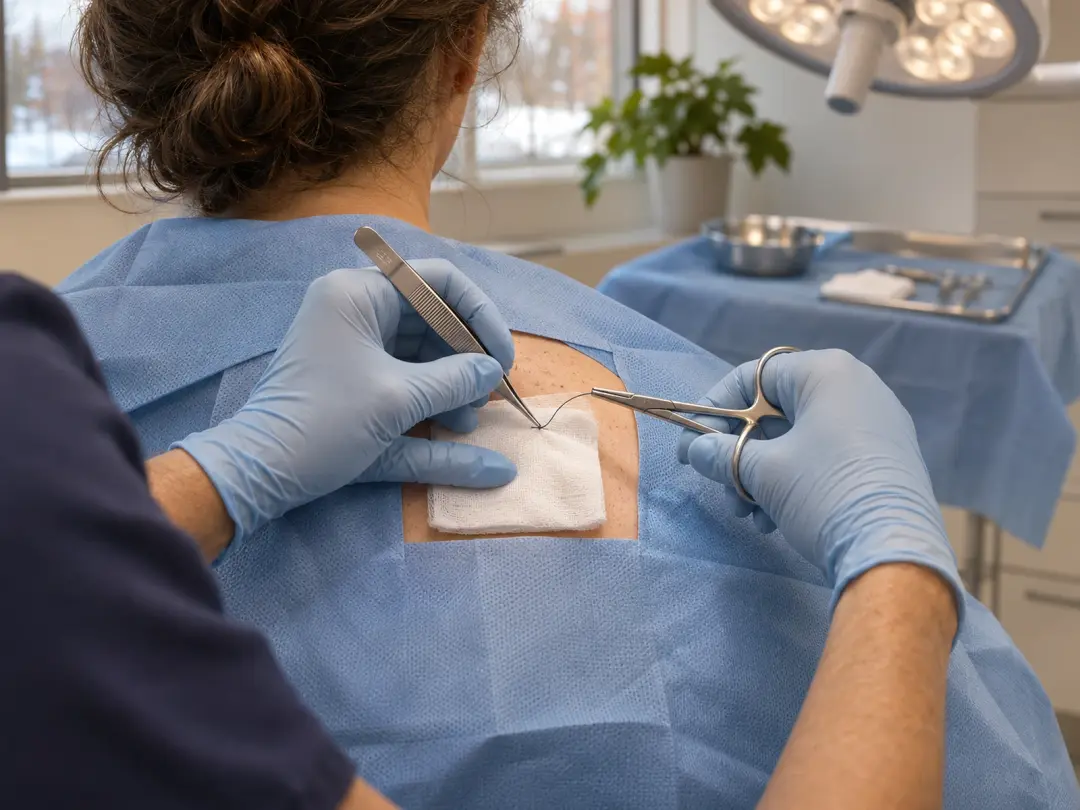
The reassuring part is that most skin cancer surgery is a minor procedure. It is usually done in clinic, under local freezing, and you go home the same day.
This page explains the main types of skin cancer surgery, what happens on the day, and what to expect while you heal.
Assessment before treatment. Every skin lesion is assessed before any treatment. The assessment combines Dr. Bastien's clinical experience and dermatology training with dermoscopy, digital imaging and AI-assisted analysis where appropriate.
Physician-led
Every spot is assessed and every surgery performed by Dr. Bastien
In-clinic surgery
Dr. Bastien is authorized by the CPSO to perform surgical excisions on the face and body, including wound closures up to the level of a skin flap
Lab-checked
Removed tissue is sent to a pathology lab to confirm the diagnosis and the margins
Quick answers
Is it major surgery?
Usually not. Most are minor, in-clinic procedures under local freezing.
Does it hurt?
You feel the freezing needle, then pressure only. Soreness after is usually mild.
How long does it take?
About 30 to 60 minutes for most excisions
Healing time?
Stitches out in 5 to 14 days. The scar settles over 9 to 12 months.
Is it covered by OHIP?
Yes, medically necessary skin cancer surgery is covered
Do I need a referral?
No referral is needed to book an assessment
Which skin cancers are treated with surgery?
The three most common skin cancers are all usually treated by removing them.
Basal cell carcinoma (BCC)
How common: The most common. How it behaves: Grows slowly and very rarely spreads, but can damage nearby skin if left.
Squamous cell carcinoma (SCC)
How common: Second most common. How it behaves: Can grow faster and occasionally spreads, so prompt removal matters.
Melanoma
How common: Less common. How it behaves: The most likely to spread, so early removal is important.
Surgery also removes the tissue so a lab can confirm exactly what it was and whether it is fully out.
Types of skin cancer surgery
The right method depends on the cancer type, size, depth and location.
Surgical excision
How it works: The cancer is cut out with a small border of normal skin, then stitched
Often used for: Most BCCs and SCCs, and suspicious moles
Excision with skin flap
How it works: Nearby skin is moved to close a larger wound neatly
Often used for: Larger cancers, or areas like the nose and face
Curettage and electrodesiccation
How it works: The cancer is scraped away and the base is treated with heat
Often used for: Small, superficial BCCs and SCCs on the body
Cryotherapy
How it works: Freezing with liquid nitrogen
Often used for: Precancerous spots and some very superficial cancers
Photodynamic therapy (PDT)
How it works: A light-activated cream destroys abnormal cells
Often used for: Precancerous spots and selected superficial BCCs
Mohs surgery
How it works: Layer-by-layer removal checked under a microscope during surgery
Often used for: Selected high-risk facial cancers, by referral
Dr. Bastien offers excision, skin flap closure, curettage and electrodesiccation, cryotherapy and PDT in clinic. When Mohs surgery, wider surgery or further tests are needed, he arranges a referral.
How quickly should skin cancer be removed?
It depends on the type. Earlier treatment usually means a smaller surgery and a smaller scar.
Basal cell carcinoma
Within weeks to a few months is generally safe.
Squamous cell carcinoma
Within a few weeks.
Melanoma
As soon as possible, usually within a few weeks.
In the UK, a "2-week rule" means a suspected cancer referral is seen within two weeks. Ontario has no such rule, but suspected melanoma and fast-growing spots are prioritized.
What happens on the day of surgery
- 1
Marking
The area and margin are marked, and photos are taken
- 2
Freezing
Local anaesthetic is injected. This stings for a few seconds.
- 3
Removal
The cancer and a border of normal skin are removed. You feel pressure, not pain.
- 4
Closure
The wound is stitched, sometimes using a skin flap
- 5
Dressing
A pressure dressing is applied and you get written aftercare instructions
Most excisions take about 30 to 60 minutes. You are awake throughout and can usually drive yourself home, unless the surgery is near the eye.
How painful is it? The freezing needle is the only sharp part. Afterwards, most people need only acetaminophen for a day or two.
Not sure this is the right treatment?
Every spot is assessed before anything is treated. If another option suits you better, Dr. Bastien will tell you.
Recovery after skin cancer surgery
- 1
First 48 hours
Keep the dressing dry and on. Mild soreness, swelling or bruising, especially on the face.
- 2
After 48 hours
You can usually shower. Clean gently and apply petroleum jelly daily.
- 3
Days 5 to 14
Stitches come out: about 5 to 7 days on the face, 10 to 14 days on the body
- 4
Weeks 2 to 6
Wound is closed. Scar is pink and may feel firm.
- 5
Months 3 to 12
Scar flattens and fades. Most settle by 9 to 12 months.
What not to do after skin cancer surgery
- Don’t swim, use hot tubs or soak the wound until stitches are out and it has closed
- Avoid heavy lifting, bending and hard exercise for about 1 to 2 weeks
- Avoid alcohol and, if your doctor agrees, non-essential blood thinners for a few days
- Don’t smoke, as it slows healing
- Don’t pick at scabs or stitches
- Don’t expose the scar to sun without protection for a year
Call the clinic if you notice spreading redness, increasing pain, pus, a fever or bleeding that does not stop with 20 minutes of firm pressure.
What happens after the cancer is removed?
The removed tissue goes to a pathology lab. Results usually take about 1 to 2 weeks.
The report confirms the type of cancer and whether the edges (margins) are clear. If cancer cells reach the edge, a second, small excision may be advised.
Long-term follow-up matters. Having one skin cancer raises the chance of another. Regular full-skin checks, often every 6 to 12 months at first, help catch new spots early.
Can surgery remove skin cancer completely?
For basal and squamous cell carcinomas found early, surgical excision has high success rates. Most people need no further treatment beyond follow-up checks.
Melanoma outcomes depend mainly on how thick it is when removed. Thin, early melanomas have the best outcomes, which is why early assessment matters so much.
Where does skin cancer spread? When melanoma or SCC spreads, it usually goes first to nearby lymph nodes. Many skin cancers take months to years to spread, but melanoma can move faster, so suspicious spots should not wait.
Skin cancer on the face and nose
The face, nose, ears and lips are common sites because of sun exposure. Surgery here is planned to remove the cancer fully while keeping the best possible look and function.
- Skin flaps can close wounds on the nose and cheeks with less distortion
- Scars are placed along natural skin lines where possible
- Some high-risk facial cancers are best treated with Mohs surgery, which is arranged by referral
Cost and OHIP coverage
In Ontario, OHIP covers medically necessary assessment, biopsy and surgery for skin cancer.
Related treatments
- Basal Cell Carcinoma TreatmentDiagnosis and in-clinic treatment of basal cell carcinoma, the most common skin cancer, by surgery, scraping, freezing or light therapy.
- Squamous Cell Carcinoma TreatmentDiagnosis and treatment of squamous cell carcinoma and SCC in situ (Bowen’s disease), most often by surgical removal.
- Curettage and ElectrodesiccationScraping and heat for small, low-risk skin cancers and some harmless growths. The wound heals without stitches.
Frequently asked questions
Is skin cancer surgery major surgery?
Usually not. Most are minor, in-clinic procedures done under local freezing, and you go home the same day. Larger or spread cancers may need hospital surgery.
How painful is skin cancer surgery?
The freezing needle stings for a few seconds. After that, you feel pressure only. Most people need only acetaminophen for a day or two afterwards.
How long does skin cancer surgery take to heal?
Stitches come out in 5 to 14 days. The scar keeps improving for 9 to 12 months.
How long can I wait to have skin cancer removed?
Basal cell carcinomas can usually wait a few weeks to months. Squamous cell carcinomas and melanomas should be removed within a few weeks.
Can skin cancer be treated without surgery?
Some very superficial cancers and precancerous spots can be treated with cryotherapy, PDT or prescription creams. Most invasive skin cancers are best removed surgically.
Can skin cancer come back after surgery?
It is uncommon when margins are clear, but it can recur. New skin cancers can also appear elsewhere, so regular skin checks are important.
When can I shower or swim after surgery?
You can usually shower after 48 hours. Avoid swimming and soaking until the stitches are out and the wound has fully closed.
Do I need a referral for skin cancer surgery in Ontario?
No. You can book an assessment directly at 1692 Murphy Rd, Sarnia, by calling 1-866-550-MOLE (6653).
Book a consultation
You don’t need a referral. Dr. Bastien examines the area first and tells you whether you need treatment.
1692 Murphy Rd, Sarnia
Monday to Friday, 8:30 am to 4:30 pm
Free parking on site