Skin Cancer Assessment and Referrals in Sarnia
Found a spot that worries you? Get it looked at by a physician, with a clear answer on what happens next.
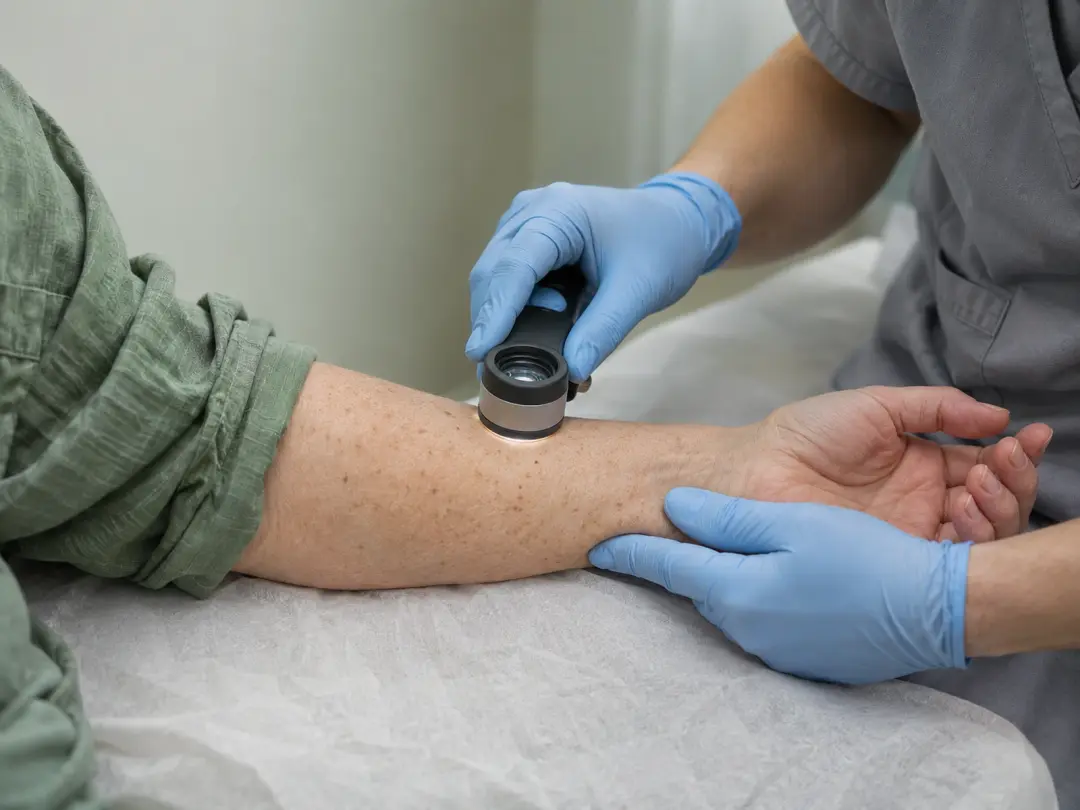
At a glance
No referral needed.
Dr. David Bastien, [title / designation], assesses new, changing and suspicious skin spots at 1692 Murphy Rd, Sarnia, for patients across Sarnia and Lambton County.
- Physician exam of the spot that concerns you, with dermoscopy
- A clear plan before you leave: reassure, watch, biopsy or refer
- Referral on to the right care team when needed
- [Referral needed / self-referral welcome: TO CONFIRM]
What is a skin cancer assessment?
It is a visit where a physician examines a spot you are worried about and decides whether it needs more testing. It is the first step, not a diagnosis.
Most spots turn out to be harmless. The goal is to find the few that are not, as early as possible.
The assessment looks for the three most common skin cancers and for precancerous spots:
Basal cell carcinoma
What it often looks like: Shiny, pearly or pink bump; a sore that bleeds, crusts and comes back. Where it often appears: Face, ears, neck and other sun-exposed skin.
Squamous cell carcinoma
What it often looks like: Rough, scaly or crusted patch or firm bump that may be tender. Where it often appears: Face, scalp, lips, hands and arms.
Melanoma
What it often looks like: A new or changing mole, often dark or multicoloured. Where it often appears: Anywhere, including skin that rarely sees the sun.
Actinic keratosis (precancer)
What it often looks like: Dry, rough, scaly patch you feel more than see. Where it often appears: Face, scalp, backs of hands.
These are general descriptions. Many harmless spots look similar, so only an exam can tell them apart.
Skin Cancer Assessment: specific treatments
- Basal Cell Carcinoma TreatmentDiagnosis and in-clinic treatment of basal cell carcinoma, the most common skin cancer, by surgery, scraping, freezing or light therapy.
- Squamous Cell Carcinoma TreatmentDiagnosis and treatment of squamous cell carcinoma and SCC in situ (Bowen’s disease), most often by surgical removal.
- Actinic Keratosis TreatmentTreatment of rough, scaly sun-damage patches with freezing, scraping, prescription creams or light therapy.
Warning signs: when to get a spot checked
People often search for the "5" or "7" warning signs. There is no single official list, but these are the changes worth showing a doctor.
For moles, use the ABCDE guide:
- A
Asymmetry. The two halves do not match
- B
Border. Edges are uneven, jagged or blurry
- C
Colour. More than one colour, such as brown, black, red, white or blue
- D
Diameter. Wider than about 6 mm (a pencil eraser)
- E
Evolving. Changing in size, shape, colour or feel
Also book an assessment if you notice:
- A new spot that looks different from your other moles
- A sore that does not heal within a few weeks
- A spot that bleeds, oozes or crusts without injury
- A shiny or pink bump that keeps growing
- A rough, scaly patch that does not go away
- Itching, tenderness or pain in a single spot
- Redness or swelling spreading beyond the edge of a mole
How to get assessed in Sarnia
- 1
Check if you need a referral
[TO CONFIRM: you can book directly / ask your family doctor or nurse practitioner to send a referral.]
- 2
Book your visit
Call [phone] or [book online]. Tell us if the spot is changing quickly or bleeding.
- 3
Bring what helps
A list of spots that worry you, photos showing changes, and any past biopsy results.
- 4
Get your assessment
Dr. Bastien examines the spot and explains what he sees.
- 5
Leave with a plan
You know the next step, who is doing it, and when.
No family doctor? You can register with Health Care Connect to find one. [Whether patients without a family doctor can self-refer here: TO CONFIRM]
How the assessment works
The visit is short and practical. There are no needles unless a biopsy is needed and you agree to it.
- 1
History
We ask how long the spot has been there, how it has changed, and about sunburns and family history.
- 2
Exam
Dr. Bastien examines the spot and, if helpful, the rest of your skin. [Full-skin exam at every visit: TO CONFIRM]
- 3
Dermoscopy
A handheld lighted magnifier shows patterns under the skin surface that the eye cannot see.
- 4
Decision
Dr. Bastien explains whether the spot looks reassuring or needs more testing.
- 5
Next step
A biopsy, a shorter check-up, treatment, or referral, explained before you leave.
A biopsy examined in a lab is the only way to confirm a skin cancer diagnosis.
Not sure this is the right treatment?
Every spot is assessed before anything is treated. If another option suits you better, Dr. Bastien will tell you.
What the possible outcomes are
Reassured
What it means: The spot looks harmless. What happens next: Keep checking your skin; come back if it changes.
Watch
What it means: The spot needs a second look over time. What happens next: A photo and a follow-up visit in [X] months.
Biopsy
What it means: A sample is needed to confirm what it is. What happens next: [In clinic / referred: TO CONFIRM]; results in about [X] weeks.
Treat
What it means: A precancer or confirmed skin cancer that can be managed here. What happens next: Treatment options explained, such as [PDT, excision: TO CONFIRM].
Refer
What it means: The spot needs care from another team. What happens next: Referral sent to [dermatology / plastic surgery / cancer centre: TO CONFIRM].
Wait times and urgency
Wait times to see a dermatologist in Ontario can be long. A 2016 study found average waits of about 9 weeks for urgent and 12.7 weeks for non-urgent medical appointments.
At our clinic, new assessments are usually seen within [TO CONFIRM]. [Urgent slots for fast-changing spots: TO CONFIRM]
A spot that is changing quickly, bleeding or growing over weeks
Call us and say so when you book.
A mole or patch that has changed over months
Book an assessment soon.
A spot you are unsure about, with no change
Book a routine check.
Feeling very unwell, or severe pain or bleeding
Go to your nearest emergency department.
What is the "2-week rule"? It is a UK health service target for urgent suspected cancer referrals, introduced in 2000. It is not an Ontario standard. If a spot worries you here, do not wait: book an assessment or see your family doctor.
Why early assessment matters
Most skin cancers grow slowly, but they do not go away on their own. Left alone, basal and squamous cell cancers can grow into nearby tissue.
Melanoma can spread, usually first to nearby lymph nodes. Finding it while it is thin and only in the skin gives the best chance of successful treatment.
- In Canada, about 90% of people diagnosed with melanoma live at least 5 years.
- For the earliest stage (1A), melanoma-specific survival at 5 years is about 99%.
These are averages for groups of people. Your doctor is the best person to explain what any result means for you.
Cost and OHIP coverage
In Ontario, OHIP covers medically necessary assessment of a suspicious spot. A referral may be needed for OHIP coverage. Cosmetic removal of harmless spots is not covered.
Frequently asked questions
How do I get a suspicious mole checked in Ontario?
Start with your family doctor, a nurse practitioner, or a clinic that assesses skin spots. [At our clinic: self-referral welcome / referral needed: TO CONFIRM]
How urgent is a changing mole?
A mole that is changing should be checked promptly, not watched at home. Tell the clinic it is changing when you book so it can be seen sooner.
How is skin cancer diagnosed?
A physician examines the spot, often with dermoscopy. If it looks concerning, a small sample (biopsy) is sent to a lab. The lab result confirms the diagnosis.
What does stage 1 skin cancer look like?
Early skin cancers are small and often look like a new or slightly changed mole, a pink bump, or a scaly patch. Most cause no pain. Stage is decided by the lab and doctor, not by how a spot looks.
Where does skin cancer spread first?
Basal cell cancer rarely spreads. When melanoma spreads, it usually reaches the nearest lymph nodes first, such as in the neck, armpit or groin.
Is skin cancer curable?
Many skin cancers are treated successfully, especially when found early. No doctor can promise a result, which is why early assessment matters.
How long can someone live with skin cancer?
It depends on the type and the stage when found. Most people with an early skin cancer go on to live normal lives. Ask your doctor what your result means for you.
Are there signs my body is fighting melanoma?
There are no reliable signs you can see at home. Some moles lighten or fade, but that change should also be checked.
Is there a vitamin that stops skin cancer?
No vitamin prevents skin cancer. Some studies show nicotinamide (vitamin B3) may lower the risk of new non-melanoma skin cancers in people who have already had one. Ask your doctor before starting any supplement. Sun protection remains the most important step.
How can I support someone with skin cancer?
Go with them to appointments, help them keep track of results and follow-ups, and encourage regular skin checks. The Canadian Cancer Society offers free support for patients and families.
Do I need to see a dermatologist?
Not always. Many skin spots can be assessed and managed by a physician with experience in skin cancer. If a specialist is needed, we will refer you.
What should I bring?
Your Ontario health card, a list of spots that worry you, photos of any changes, a list of medications, and any past biopsy results.
Serving Sarnia and Lambton County
Our clinic is at 1692 Murphy Rd, Sarnia, with [parking details]. We welcome patients from Sarnia, Point Edward, Bright's Grove, Corunna, Petrolia, Forest and across Lambton County.
Worried about a spot? Book an assessment. Call [phone] or [book online]. Hours: [TO CONFIRM].
Already tracking many moles? See whole-body mole mapping.
Book a consultation
You don’t need a referral. Dr. Bastien examines the area first and tells you whether you need treatment.
1692 Murphy Rd, Sarnia
Monday to Friday, 8:30 am to 4:30 pm
Free parking on site