QuadroStar Pro Yellow Laser in Sarnia, Ontario
Redness has a way of hanging around. Cheeks that flush and stay pink, thin red lines across the nose, or small red dots that keep appearing on the chest.
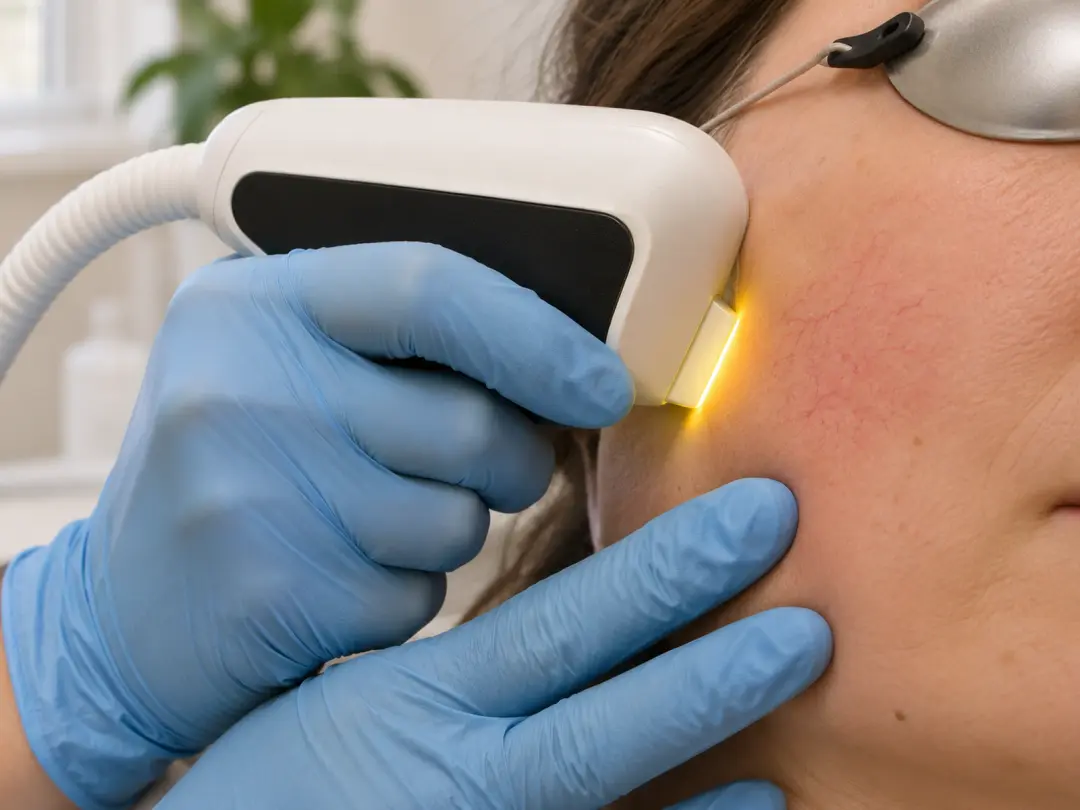
At a glance
- Healing
- Usually none
- Anaesthetic
- Usually none
- OHIP
- Private fee
No. It is a cosmetic treatment.
No referral needed.
Redness has a way of hanging around. Cheeks that flush and stay pink, thin red lines across the nose, or small red dots that keep appearing on the chest. Makeup covers them, but they are still there at the end of the day.
Most of this redness comes from small blood vessels near the skin surface. The QuadroStar Pro Yellow laser is designed to target exactly those vessels.
This page explains how the yellow laser works, what it treats, and what to expect.
Assessment before treatment. Every skin lesion is assessed before any laser treatment. The assessment combines Dr. Bastien's clinical experience and dermatology training with dermoscopy, digital imaging and AI-assisted analysis where appropriate.
Yellow light at 577 nm
Strongly absorbed by blood, so it targets vessels while sparing the skin surface
Gentle
Most people return to normal activities the same day
Physician-led
Every spot and area is assessed by Dr. Bastien before treatment
Quick answers
What does it treat?
Facial redness, rosacea redness, broken capillaries, cherry angiomas, venous lakes and red scars
Does it hurt?
Most people feel a warm snap. No numbing is usually needed.
Downtime?
Usually none. Mild redness for a few hours to a day.
How many sessions?
1 to 2 for small spots. 2 to 4 for facial redness.
Is it covered by OHIP?
No. It is a cosmetic treatment.
Do I need a referral?
No
What is the QuadroStar Pro Yellow laser?
The QuadroStar Pro Yellow is a medical laser made by Asclepion, a German laser company. It produces yellow light at 577 nm, a wavelength chosen because it is absorbed very strongly by the red pigment in blood.
It is a non-ablative laser. It does not remove or break the skin surface, so recovery is usually quick.
How does a yellow laser work?
The laser sends short pulses of yellow light into the skin. The blood inside small vessels absorbs the light and heats up.
- The heat seals the tiny vessel from the inside
- Over the next few weeks, the body clears the sealed vessel away
- The skin around it absorbs far less light, so it is largely spared
- With fewer visible vessels, redness and red spots fade
The laser also delivers energy in a controlled, low-heat way, which is part of why it is generally gentle on the skin.
What can it treat?
Rosacea-associated redness
What it looks like: Persistent flushing and pink cheeks, nose or chin. Typical sessions: 2 to 4.
Broken capillaries (telangiectasia)
What it looks like: Thin red lines on the nose and cheeks. Typical sessions: 1 to 3.
Cherry angiomas
What it looks like: Small bright red dots, often on the body. Typical sessions: 1 to 2.
Venous lakes
What it looks like: Soft dark blue or purple bumps on lips or ears. Typical sessions: 1 to 2.
Small hemangiomas
What it looks like: Red or purple raised spots made of vessels. Typical sessions: 1 to 3.
Spider angiomas
What it looks like: A red dot with tiny lines spreading out. Typical sessions: 1 to 2.
Red scars and red acne marks
What it looks like: Pink or red marks after surgery or acne. Typical sessions: 2 to 4.
Rosacea is ongoing. The laser reduces visible redness and vessels, but it does not cure rosacea. Triggers like sun, heat, alcohol and spicy food can bring redness back, so occasional touch-up sessions are common.
What it does not treat: large leg veins, tattoos, hair removal, and moles. Any spot that could be a skin cancer is checked first, not lasered.
Yellow laser vs IPL
IPL (intense pulsed light) is often offered for redness too. They are different technologies.
| QuadroStar Pro Yellow laser | IPL | |
|---|---|---|
| Light | One exact wavelength, 577 nm | A broad range of wavelengths |
| Target | Blood in small vessels | Blood and brown pigment together |
| Precision | Can trace individual vessels and tiny spots | Treats wider areas less precisely |
| Darker skin | Generally lower risk with careful settings | Higher risk of burns and colour change |
| Best for | Defined vessels, red spots, venous lakes | Mixed redness and sun spots on light skin |
This clinic uses the yellow laser rather than IPL for vascular concerns.
What happens during treatment
- 1
Assessment
Dr. Bastien examines the redness or spot, often with dermoscopy, and confirms it is vascular
- 2
Preparation
Skin is cleansed of makeup. You wear eye shields.
- 3
Treatment
The laser handpiece is moved over the area. Small spots take minutes, a full face about 15 to 20 minutes.
- 4
Aftercare
A cool compress or soothing cream may be applied. You can usually drive home and return to work.
Most people describe the feeling as a warm snap, like a light rubber band. A cooling device may be used for comfort.
Not sure this is the right treatment?
Every spot is assessed before anything is treated. If another option suits you better, Dr. Bastien will tell you.
Recovery and side effects
- 1
First few hours
Mild redness and warmth, like a light sunburn
- 2
Day 1 to 2
Slight swelling, more often under the eyes
- 3
Days 2 to 7
Small spots may darken or form a tiny crust before fading
- 4
2 to 6 weeks
Treated vessels keep fading as the body clears them
Bruising is uncommon, because the laser seals vessels without bursting them. Rarely, temporary light or dark patches or blistering can occur.
Aftercare tips
- Use a gentle cleanser and moisturizer for a few days
- Avoid hot showers, saunas, alcohol and heavy exercise for 24 to 48 hours
- Use broad-spectrum SPF 30 or higher every day
- Don’t pick at any small crusts
Who should wait or avoid treatment?
- Pregnant or breastfeeding
- A fresh tan, sunburn or self-tanner in the past 2 weeks
- Active infection or cold sores in the area
- Taking medicines that make skin sensitive to light
- Isotretinoin (Accutane) in the past 6 months
Tell Dr. Bastien about any medicines at your assessment.
How long do results last?
Treated vessels and spots are usually gone for good. New ones can still form over time, especially with rosacea, sun exposure and aging.
Many people with rosacea book a touch-up session once or twice a year. Daily sun protection and avoiding known triggers help results last longer.
Results vary from person to person.
Cost of yellow laser treatment in Sarnia
Yellow laser treatment for cosmetic concerns is not covered by OHIP.
Related treatments
- Rosacea Laser TreatmentLaser treatment that fades persistent rosacea redness and visible vessels on the face, usually over 3 to 4 sessions.
- Hemangioma Laser TreatmentLaser removal of cherry angiomas, the small bright red spots on the body, often in one short visit.
- Venous Lake Laser TreatmentLaser treatment for venous lakes, the soft blue-purple bumps on the lip, face or ears.
- Acne Scar TreatmentErbium laser resurfacing and other treatments that soften acne scars over a series of sessions.
Frequently asked questions
What is the QuadroStar Pro Yellow laser used for?
It treats redness and blood vessel concerns: rosacea redness, broken capillaries, cherry angiomas, venous lakes, small hemangiomas and red scars.
Does the yellow laser hurt?
Most people feel a warm snap. Numbing cream is rarely needed.
Is there any downtime?
Usually not. Mild redness lasts a few hours to a day, and most people go back to work the same day.
Can it cure rosacea?
No. It reduces visible redness and vessels, but rosacea is a long-term condition. Touch-ups and trigger control help keep results.
Is a yellow laser better than IPL?
They work differently. The yellow laser uses one exact wavelength for precise vessel treatment, while IPL uses broad light. The right choice depends on your skin and concern.
How many sessions will I need?
Small red spots often clear in 1 to 2 sessions. Facial redness usually needs 2 to 4, about 4 weeks apart.
Is it safe for darker skin?
Often yes, with careful settings. Darker skin has some risk of temporary colour change, so a test spot may be suggested.
Do I need a referral?
No. You can book an assessment directly at 1692 Murphy Rd, Sarnia, by calling 1-866-550-MOLE (6653).
Book a consultation
You don’t need a referral. Dr. Bastien examines the area first and tells you whether you need treatment.
1692 Murphy Rd, Sarnia
Monday to Friday, 8:30 am to 4:30 pm
Free parking on site