Lipoma Removal in Sarnia, Ontario
A lipoma is a soft, slow-growing lump of fat under the skin. Most are harmless and need no treatment. Some are removed because they grow, press on something, hurt, or sit where they are in the way.
At a glance
- Visit
- About 20 to 40 minutes
- Anaesthetic
- Local anaesthetic
- OHIP
- OHIP may cover
Often not when removal is by choice. A medical reason can change this.
No referral needed.
Usually harmless
A lipoma is not cancer, but only an examination can confirm what a lump is
Often left alone
A small, painless lipoma that is not changing can be watched
Removal is a minor procedure
Usually a small cut under local anesthetic, with the patient awake
Some lumps need checking first
Large, deep, firm, painful or fast-growing lumps may need imaging
Not for home treatment
Creams, sprays and squeezing do not remove a lipoma
Quick answers
Is a lipoma cancer?
No. A lipoma is a benign (non-cancerous) fatty lump. A rare cancer of fat can look similar, so unusual lumps are checked.
Does it have to come out?
Not usually. Removal is a choice unless it is painful, growing or causing problems.
How is it removed?
By excision through a small cut. Liposuction is another method for some lipomas.
Does it hurt?
The injection stings briefly, then the area is numb. Soreness for a few days is common.
How long does it take?
About 20 to 40 minutes for a typical lipoma
Can it come back?
After complete removal it is uncommon, but it can happen. A new lipoma can also form nearby.
Is it covered by OHIP?
Often not when removal is by choice. A medical reason can change this.
What is a lipoma, and what causes it?
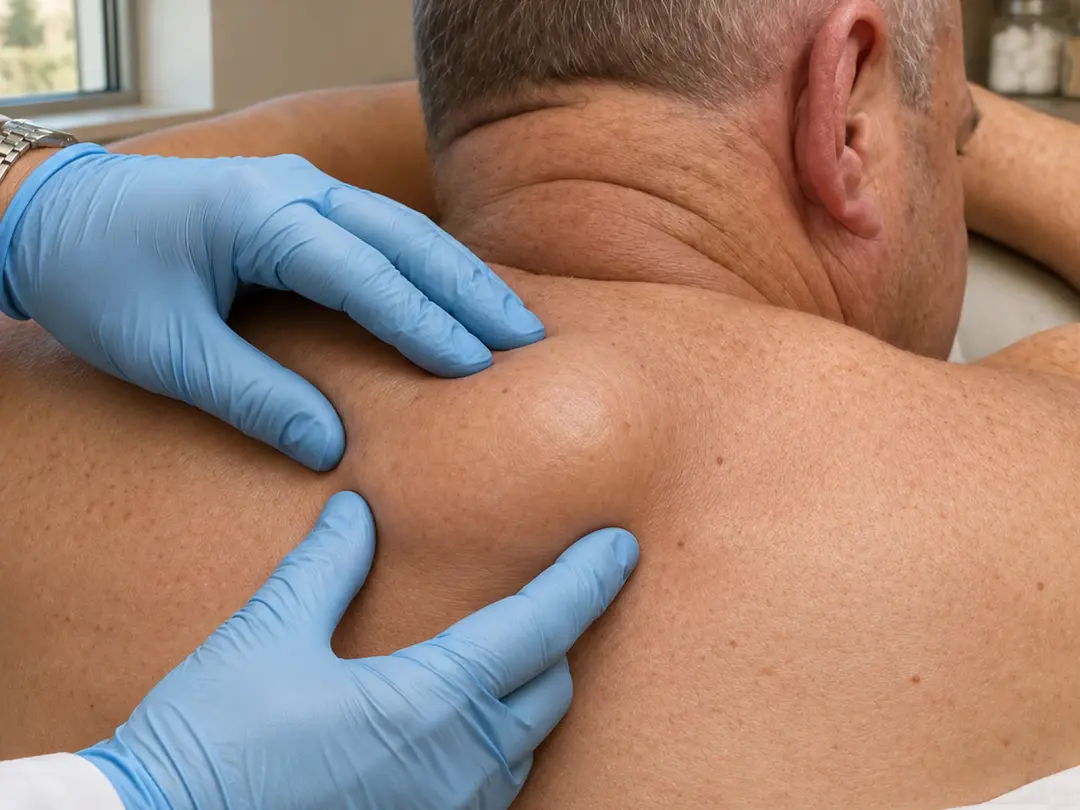
A lipoma is a round or oval collection of fat cells that grows slowly under the skin. It is usually soft or doughy and moves a little when pressed. Most are painless.
Other names
- Fatty lump or fatty tumour. Here "tumour" means a growth, and a lipoma is benign.
- Subcutaneous lipoma, meaning a lipoma just under the skin
- The procedure is called lipoma removal, lipoma excision or lipoma surgery
Where lipomas appear
Lipomas can form wherever there is fat under the skin. They are most often found on the shoulders, back, neck, arms and thighs. Some form deeper, in or between muscles.
What causes a lipoma?
The cause is not fully understood. These are the explanations that are discussed:
Family history
Some people with several lipomas have relatives with them. A rare inherited condition, familial multiple lipomatosis, causes many.
An earlier injury
A link between a knock to an area and a lipoma has been suggested, but it is not proven.
Other health factors
Some sources list weight, cholesterol or diabetes as possible links, but these are weak and not established causes.
No well-established risk factors or ways to prevent a lipoma have been identified.
Why do new lipomas appear?
Some people develop one lipoma, others develop several over the years. A new lump is worth having examined, because not every new lump is a lipoma.
How many lipomas are normal?
Most people who have a lipoma have just one. Having a few is not unusual. Having many lipomas is less common and is worth discussing with a doctor.
Can a lipoma go away on its own?
Rarely. A lipoma usually stays the same size or grows slowly.
Lipoma or something else? Warning signs to check
Several lumps can look alike from the outside. Only a clinician who has examined the lump can say what it is.
Lipoma
Soft or doughy, moves slightly under the finger, usually painless, no central opening, grows slowly.
Epidermoid cyst
Firmer, dome-shaped, often with a small central pore. Can become red, sore or infected.
Pilar cyst
Firm and smooth, usually on the scalp.
Swollen lymph node
Often in the neck, armpit or groin. May be tender during an infection.
Fatty cancer (liposarcoma)
Rare. Often deeper, larger, firmer and growing. It can look like a lipoma at first.
These are general descriptions. A lump can match one row and still be another.
Is a lipoma cancer? Can it turn into cancer?
A lipoma is benign. Having a lipoma does not make someone more likely to develop a fatty cancer, and a lipoma turning cancerous is exceedingly rare.
The real concern is a lump thought to be a lipoma that is actually a rare cancer of fat from the start. That is why larger or unusual lumps are checked before or during removal.
When a lump should be checked soon
- It is larger than about 5 cm (roughly a golf ball), or has grown quickly
- It feels hard or fixed and does not move under the skin
- It sits deep, under or within muscle, rather than just under the skin
- It is painful, or becomes painful after being painless
- Its feel or shape has changed from how it used to be
- It came back after earlier removal
- It is on a child
No single sign means cancer. These features mean the lump deserves an exam, and sometimes imaging, before anyone assumes it is a lipoma.
Why would a lipoma be painful?
Most lipomas are painless. Pain can come from a lipoma pressing on a nerve, being in a spot that rubs or gets bumped, or being a type that is tender, such as an angiolipoma. A painful lump should still be examined.
What tests can be used?
Examination
The usual way a typical lipoma is recognised
Ultrasound or MRI
May be advised when a lump is large, deep, painful, growing or unusual
Tissue testing
A removed lump, or a sample of it, can be sent to a lab to confirm what it is
A lump that looks and feels like a typical lipoma may not need imaging.
Does a lipoma need to be removed?
Usually not. A lipoma that is small, painless and not changing can be left alone and checked now and then. Whether to remove one is mostly a personal choice.
| Reasons people choose removal | Reasons people choose to wait |
|---|---|
| It is growing | It is small and not bothering them |
| It is painful or tender | It is painless and not changing |
| It presses on a nerve or limits movement | They would rather avoid a scar |
| It rubs on clothing, a bag strap or a seat | They do not want to pay for removal |
| It is in a visible spot and bothers them | A clinician has confirmed what it is |
| The diagnosis is uncertain and a lab test is wanted | They would rather watch it for now |
Is it worth getting a lipoma removed?
That depends on what the lipoma does to you. If it is bothering you, removal is a reasonable option. If it is not, there is no medical need to hurry.
Weigh these points:
- For removal: the lump is gone, a diagnosis can be confirmed, and a small lipoma needs only a small cut
- Against removal: a scar always remains, there is a cost, there are a few days of soreness, and a lipoma can sometimes return or a new one can form nearby
Why do some doctors advise against removing lipomas?
A harmless lipoma does not need treatment, and removal always leaves a scar. Advice to leave one alone is about medical need. It does not mean removal is unsafe when you want it done.
What happens if a lipoma is not removed?
Most stay the same or grow slowly. A lipoma left alone is very unlikely to turn into cancer. If you choose to wait, have it re-checked if it grows, becomes painful or changes in feel.
A larger lipoma generally needs a longer cut to remove than a small one. Growth can change the scar later.
Is lipoma removal an emergency?
No. A typical lipoma is not an emergency, and removal can be planned for a time that suits you.
Non-surgical options, creams and home treatment
Can a lipoma be treated without surgery?
Sometimes it can be reduced, but surgical removal is the most reliable way to take a lipoma out. Non-surgical options are limited and have less evidence behind them.
Watchful waiting
What it does: Nothing is done. The lump is checked if it changes.
Limits: The lipoma stays
Steroid injection
What it does: Can shrink a lipoma by thinning the fat
Limits: Rarely removes it completely
Deoxycholic acid injection
What it does: An injection that breaks down fat cells. It has been reported in case reports and small series.
Limits: It is approved for fat under the chin, not for lipomas. Evidence is limited. Several sessions may be needed.
Liposuction or laser lipolysis
What it does: Removes or melts fat through a small opening
Limits: The capsule may be left, so it can come back more often than after excision
Do lipoma creams, sprays and herbal products work?
There is no reliable evidence that creams, sprays, patches, oils or herbal products remove a lipoma. A lipoma sits under the skin, so a product applied on the surface is not expected to dissolve it.
If a product claims to remove a lipoma at home, ask what evidence supports it before paying for it.
Can you remove a lipoma at home?
It is not safe to try. Cutting, squeezing or using a needle can cause bleeding, infection and scarring. A lump you think is a lipoma may also be something else.
Safe things to do while you wait
- Avoid pressing, squeezing or poking at the lump
- Take note of its size, and check it for changes now and then
- Wear clothing and bag straps that do not rub on it
- See a clinician if it grows, becomes painful or changes in feel
How is a lipoma removed?
Lipoma removal is a minor surgical procedure, usually called lipoma excision. The aim is to take out the fatty lump, and ideally its thin capsule, through the smallest cut that allows it.
Excision
How it works: A cut is made over the lump and the lipoma is lifted out with its capsule. The skin is closed with stitches.
Points to know: The most complete method, and recurrence is uncommon. The scar is a line as long as the cut.
Minimal-incision extraction
How it works: A smaller cut is made and the fat is worked out through it
Points to know: Can leave a smaller scar. Suits smaller, soft lipomas.
Liposuction
How it works: A thin tube is passed through a small opening to suction the fat out
Points to know: Smaller scar, but the capsule may stay, so it returns more often. Not usually used for small lipomas.
How is the method chosen?
Size
Larger lipomas generally need a longer cut. Very large ones are often better removed by open surgery.
Depth
Lipomas under or within muscle may need a hospital setting or a different surgeon.
Location
Near nerves, joints or the face, the plan is made more carefully.
Certainty
If the diagnosis is not clear, imaging or open removal with lab testing is preferred.
Scar concerns
These are discussed before the choice is made.
What will Dr. Bastien use?
For a typical lipoma under the skin, excision or minimal-incision extraction under local anesthetic is the usual approach. The method is agreed with you after examination, once the size, depth and position are known.
Is lab testing done?
A removed lipoma can be sent to a lab to confirm what it is. This is advised when the lump is large, firm, deep, growing, painful or looks unusual. Lab testing costs extra, and you are told before anything is sent.
Can a lipoma be removed by a laser?
Laser lipolysis melts fat through a small opening and has been used for some lipomas. Like liposuction, it can leave part of the lipoma behind, so it returns more often than after excision. It is not the usual method for a lump that is being removed.
Before your visit
- Tell us about medicines you take, especially blood thinners, aspirin and anti-inflammatories. Do not stop a prescribed medicine without asking the doctor who prescribed it.
- Tell us about allergies, especially to local anesthetic, latex or tape
- Mention diabetes, a pacemaker, or a history of raised scars (keloids)
- Eat normally. You do not need to fast for local anesthetic.
- Wear loose clothing that gives easy access to the area
- Mention any earlier lumps, imaging or lab results you have
On the day
- 1
Check: the lump is examined again, and the plan, scar and fee are explained
- 2
Consent: you sign a consent form for the procedure
- 3
Cleaning and marking: the skin is cleaned, and the area is marked
- 4
Numbing: a local anesthetic is injected
- 5
Removal: a cut is made and the lipoma is lifted out, ideally in one piece
- 6
Closing: any bleeding is controlled and the skin is closed with stitches
- 7
Dressing: a dressing is applied, sometimes with a firm pressure bandage
- 8
Home: you go home the same day with written aftercare instructions
How long does lipoma removal take?
The procedure usually takes about 20 to 40 minutes. Plan for the visit to run a little longer, to allow for the check, consent and aftercare instructions.
Do I need general anesthesia?
No, not for a typical lipoma. Local anesthetic is used and you stay awake. Very large or deep lipomas may need sedation or general anesthesia in a hospital, with a different surgeon.
Can I drive after lipoma removal?
Most people can drive home after a procedure under local anesthetic. A lipoma on the shoulder, arm or leg can make turning the wheel or using pedals uncomfortable, so arrange a ride if you are unsure.
Can several lipomas be removed at once?
Sometimes. Several small lipomas can often be removed in one visit. The number depends on their size, where they are and how long you can lie comfortably. If you have many, the doctor may spread them over more than one visit. Each extra lipoma at the same visit has a lower fee, as shown in the cost section.
Pain, recovery and aftercare
Does lipoma removal hurt?
The numbing injection stings or burns for a few seconds. After that, you should feel pressure or tugging but not sharp pain.
Once the anesthetic wears off, the area is usually sore for a few days. Plain acetaminophen is often enough. Ask your pharmacist or doctor what is safe for you.
Recovery timeline
- 1
First 24 to 48 hours
Mild soreness, swelling, some bruising and a little oozing. Keep the dressing on and dry.
- 2
After 24 to 48 hours
Showering is usually allowed as instructed. Pat the area dry.
- 3
First week
Avoid heavy lifting, hard workouts and movements that pull on the cut
- 4
7 to 14 days
Stitches, if non-dissolving, are removed
- 5
2 to 3 weeks
Most wounds are well healed. Baths, pools and hot tubs are usually allowed once the wound has closed.
- 6
9 to 12 months
The scar keeps softening and fading
Most people return to desk work within a day or two. Heavy work or a lipoma on the back, shoulder or thigh may need a few days to a week off, depending on the job.
How long until I can shower, swim or exercise?
Showering
Usually after 24 to 48 hours, with the dressing kept dry or replaced as instructed
Baths, pools and hot tubs
Not until the stitches are out and the wound has closed
Exercise
Light walking is usually fine. Avoid hard exercise, gym work and contact sports until the stitches are out and the area has healed.
Aftercare basics
- Keep the dressing clean and dry for the first 24 to 48 hours
- A cold pack wrapped in a cloth for 15 to 20 minutes can ease swelling. Do not put ice directly on the skin.
- Keep the area still where you can, and avoid stretching the skin over the cut
- Do not pick at stitches, scabs or glue
- Protect a healed scar from the sun
Call the clinic if
- The area becomes increasingly red, hot, swollen or painful
- It oozes pus or the wound opens up
- You develop a fever
- Bleeding does not stop with firm pressure for 10 minutes
- Numbness or tingling does not improve as the anesthetic wears off
Scarring, risks and recurrence
Will lipoma removal leave a scar?
Yes. Any cut through the skin leaves a scar. It is usually a fine line that fades over many months. Smaller lipomas generally leave smaller scars.
Size of the lipoma
A bigger lipoma generally needs a longer cut.
Method
Minimal-incision methods and liposuction use a smaller opening.
Location
Some areas are harder to keep still while healing, and tension on the wound can widen a scar.
Your skin
Some people scar more than others. Raised scars (keloids) are uncommon.
Aftercare
Keeping tension off the wound and protecting the scar from sun helps.
Risks of lipoma removal
Lipoma removal is a minor procedure and most people recover without problems. Possible risks are:
- Bleeding or bruising
- Soreness and swelling for a few days
- Infection
- A fluid pocket under the skin (seroma) that may need draining
- A wound that opens, or a stretched or lumpy scar
- Numbness or tingling near the scar. Nerve injury is uncommon.
- A dip in the skin where a large lipoma sat
- The lipoma coming back
Is lipoma removal serious or dangerous?
For a typical lipoma under the skin, removal under local anesthetic is a routine minor procedure. Larger or deeper lipomas carry more risk and are planned more carefully, sometimes in a hospital.
Can lipoma removal cause nerve damage?
It is uncommon. Nerves run near some lipomas, especially in the neck, shoulder and arm, so the surgeon takes care in these areas. Numbness near the scar is more usual than lasting nerve problems.
Can a lipoma grow back after removal?
It can, though it is uncommon after complete excision. Published reports put recurrence after excision in the low single digits, and it is higher after liposuction.
Why do lipomas come back?
- A part of the lipoma or its capsule was left behind
- Liposuction or laser was used, which can leave the capsule
- The lipoma had a deeper part that was hard to reach
- A new lipoma formed near the old one, which is not the same as a return
No method can promise that a lipoma will not return. If one does, it is usually smaller and can be removed again.
Lipomas by body area and special cases
The area changes the method, the scar and the aftercare. These are general points.
Back
A common site. Larger back lipomas are often checked with imaging first.
Shoulder
Examined first. Avoid heavy arm use while healing, as advised.
Neck
Examined carefully. A lump here can be another condition, and nerves and other structures lie close by.
Arm and forearm
Tell us about any tingling, numbness or pain before removal.
Thigh and leg
Walking is usually fine. Hard exercise waits until stitches are out.
Chest and abdomen
Usually straightforward when small. A groin lump is checked first, because other conditions, such as a hernia, can cause lumps there.
Forehead and face
Scar placement matters most here. Deeper lipomas can sit under muscle, and the plan is made more carefully.
Hands and feet
Examined first, because other kinds of lumps are common here.
Large lipomas
A lipoma larger than about 5 cm, or one that is deep or growing, is usually checked with imaging first. Very large lipomas (over about 10 cm) are often better removed by open surgery, and may be referred to a general or plastic surgeon.
Deep lipomas
Lipomas under or within muscle can be harder to remove and may need a hospital setting. Imaging helps decide this before any cut is made.
Many lipomas
Some people have several or many lipomas. Not all need removal. The usual approach is to remove the ones that are painful, growing or bothersome. Having many can be linked to inherited conditions and is worth discussing with a doctor.
Lipomas in children
A lump on a child should be checked by a family doctor or paediatrician first. Lumps in children are not assumed to be lipomas.
Pregnancy
Elective lipoma removal can usually wait until after pregnancy. A lump that is growing quickly or painful should still be checked.
A lipoma that came back
A lump that returns in the same place after removal should be checked again, and may need imaging or lab testing.
How much does lipoma removal cost in Sarnia, and is it covered?
The fee depends on the size of the lipoma, its depth and location, and how many are removed. Fees are in Canadian dollars.
Why fees differ between clinics
Does OHIP cover lipoma removal?
Often not. OHIP covers medically necessary services, and removing a harmless lipoma by choice is usually treated as elective or cosmetic.
Coverage can be different when there is a medical reason. Examples are a lipoma that is painful, growing, limiting movement, or one that needs removal to confirm a diagnosis. Whether a service is covered is decided by Ontario's rules, not by the clinic, and we explain whether a fee applies before treatment starts.
Is lipoma removal considered cosmetic?
It depends on the reason. Removal done only for appearance is cosmetic. Removal for pain, growth, pressure on a nerve or diagnosis is a medical reason.
How can I find out if mine could be covered?
- Have your family doctor or a walk-in clinic examine the lump and note any symptoms
- Ask whether a referral to a surgeon is appropriate for your lipoma
- Ask the clinic about its billing for your situation before booking
Private health insurance
Some extended health plans pay part of a procedure, but many exclude cosmetic removal. Check your plan. A receipt is provided for any claim.
Who removes lipomas, and where in Sarnia?
Lipomas are removed by physicians trained in minor surgery, and by surgeons. Dr. Bastien Mole Clinic is at 1692 Murphy Rd, Sarnia.
Which doctor removes a lipoma?
Family doctor
Can examine the lump, advise whether it needs attention and refer you. Some do minor procedures.
Skin clinic or physician doing minor skin surgery
Removes typical lipomas under local anesthetic.
Dermatologist
Sees skin conditions, usually by referral from a family doctor.
Plastic or general surgeon
Large, deep, multiple or complicated lipomas, or ones near delicate areas.
Can my family doctor in Sarnia assess a lump and refer me?
Yes. A family doctor or walk-in clinic can examine a lump, decide whether imaging or a specialist is needed, and refer you. This is also the route to take if you want to ask about OHIP coverage.
No referral is needed to book an assessment at our clinic. You can also start with your family doctor.
Who checks a lump?
A clinician who has examined the lump. For most typical lipomas, a physical exam is enough. Imaging, such as an ultrasound, may be advised for larger, deeper or unusual lumps.
Questions worth asking any clinic
- Who will do the procedure, and what is their training?
- What size and depth of lipoma can be removed in the office?
- Will the whole lipoma and capsule be removed?
- Will the lump be sent to a lab?
- What does the fee include, such as stitch removal and follow-up?
- What happens if the lipoma turns out to be larger or deeper than expected?
Related treatments
Frequently asked questions
How can I tell whether a lump is a lipoma or something that needs urgent attention?
Only an examination can tell. A typical lipoma is soft, movable and painless, and grows slowly. A lump that is larger than about 5 cm, hard or fixed, deep, painful or growing quickly should be checked soon, because a rare cancer of fat can look like a lipoma.
Does a lipoma need to be removed?
Not usually. A small, painless lipoma that is not changing can be left alone. Removal is worth considering if it is growing, painful, pressing on a nerve, rubbing on clothing or bothering you.
What happens during lipoma removal, and does it hurt?
The area is numbed with a local anesthetic and you stay awake. The injection stings for a few seconds, then you feel pressure but not sharp pain. A small cut is made, the lipoma is lifted out and the skin is stitched. A typical lipoma takes about 20 to 40 minutes.
What is the recovery time after lipoma removal?
Most people return to normal activity in a few days. You can usually shower after 24 to 48 hours, but avoid soaking the wound and hard exercise until stitches are out. Most wounds are well healed in 2 to 3 weeks, and the scar keeps fading for about a year.
Will the lipoma come back after removal?
It can, but it is uncommon after complete excision. A return is more likely when part of the capsule is left, and with liposuction. A new lipoma can also form nearby, which is not the same as a return.
What are the risks of lipoma removal, and will it leave a scar?
A scar always remains. Other possible risks are bleeding, bruising, infection, a fluid pocket, a stretched scar, numbness near the scar and, rarely, nerve injury. Larger and deeper lipomas carry more risk and are planned more carefully.
Are there non-surgical options, and do lipoma creams work?
There is no reliable evidence that creams or sprays remove a lipoma. Steroid or deoxycholic acid injections have been used for some lipomas, but evidence is limited and they rarely remove one completely. Surgical removal is the most reliable method.
Having a lump examined in Sarnia
To have a lump examined, or to ask about removal, contact the clinic.
- Address: 1692 Murphy Rd, Sarnia, ON N7S 2Z3
- Hours: Monday to Friday, 8:30 am to 4:30 pm
- Phone: 1-866-550-MOLE (6653)
- Email: reception@drbastienmoleclinic.com
- Parking: free on site
Related pages
- Cyst removal
- Epidermoid cyst removal
- Pilar cyst removal
- Benign lesion removal
- Scar treatment assessment
- Skin cancer assessment and referrals
This page is for general information and is not a diagnosis. Only a clinician who has examined you can tell you what a lump is. Results vary from person to person.
Book a consultation
You don’t need a referral. Dr. Bastien examines the area first and tells you whether you need treatment.
1692 Murphy Rd, Sarnia
Monday to Friday, 8:30 am to 4:30 pm
Free parking on site