Epidermoid Cyst Removal in Sarnia
An epidermoid cyst is a harmless, slow-growing lump under the skin. It is the most common kind of skin cyst, and it is often called a "sebaceous cyst" even though it does not come from an oil gland.
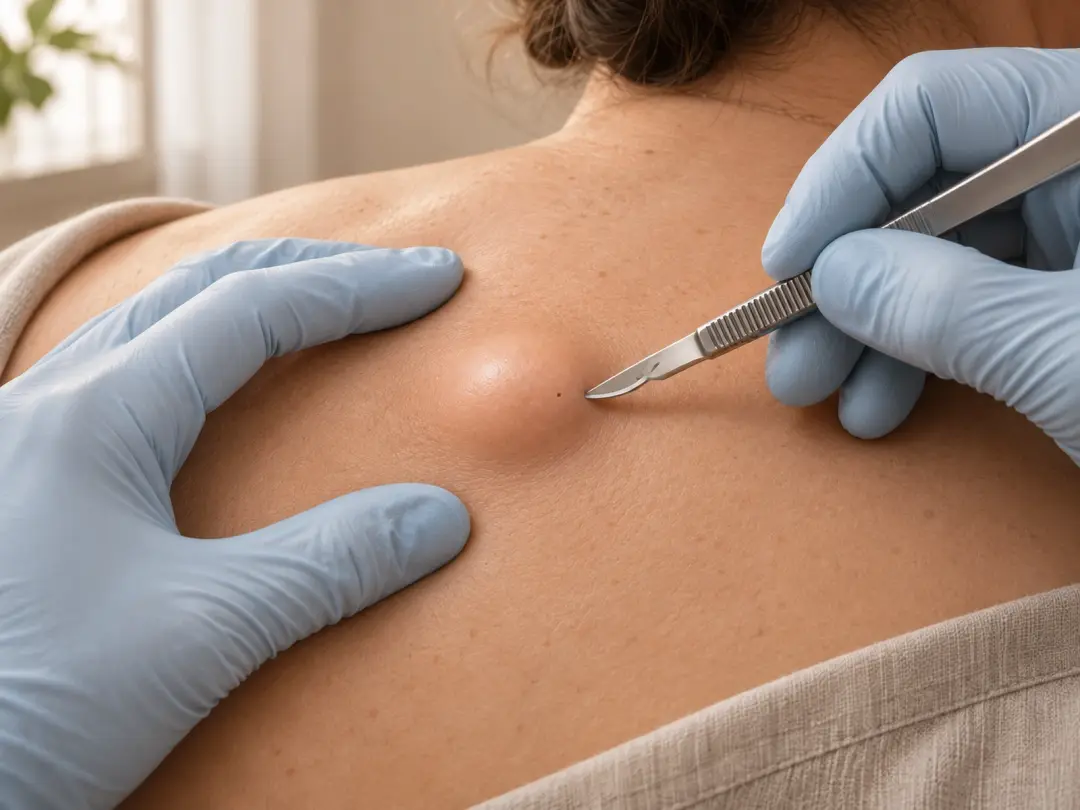
At a glance
- Visit
- About 20 to 45 minutes
- Healing
- About 5 to 14 days
- Anaesthetic
- Local anaesthetic
- OHIP
- Private fee
Usually not when removal is elective
No referral needed.
Below: how to tell an epidermoid cyst from other lumps, when removal is worth considering, how the sac is taken out, and what recovery, scarring and cost look like in Ontario.
Usually benign
Almost all are not cancer, but a new lump is best examined first
The sac matters
The cyst wall has to come out to lower the chance of it returning
Office procedure
Done under local anesthetic, and you go home the same day
Quick answers
Can it go away on its own?
It may shrink or drain, but it usually refills because the sac stays
Does it have to be removed?
No. Removal is optional unless it keeps getting inflamed or infected
Is it cancer?
Almost never. Changes into skin cancer are very rare.
How is it removed?
A small cut under local anesthetic, then the sac is taken out
How long does it take?
About 20 to 45 minutes
Does it hurt?
The numbing injection stings briefly. After that, you feel pressure.
Recovery?
Most people return to normal activity the next day. Stitches, if used, come out in about 5 to 14 days.
Will it leave a scar?
Yes. The scar is usually a fine line that fades over months.
Can it come back?
It can, especially if part of the sac is left behind
Does OHIP cover it?
Usually not when removal is elective
What is an epidermoid cyst?
An epidermoid cyst is a small closed sac in the skin. Its lining is made of cells like the outer layer of skin, and it fills with keratin, a soft, white to yellow, cheese-like material.
The lining keeps producing keratin, so the cyst slowly fills and can grow. That is why the sac, not only the contents, matters for treatment.
What it looks and feels like
- A round, dome-shaped lump under the skin, from pea-sized to several centimetres
- Skin-coloured or slightly yellow, firm to doughy, and it moves a little under the skin
- Often a tiny dark pore (punctum) on top
- Usually painless, unless it becomes inflamed
- If it opens, it can release thick, cheesy material with a strong smell
Other names for the same cyst
Epidermoid cyst
The preferred medical name.
Epidermal cyst
Another way of saying the same thing.
Epidermal inclusion cyst
Used when skin cells were pushed under the skin by an injury, piercing or surgery.
Keratin (keratinous) cyst
Named after what fills it.
Infundibular cyst
Named after the part of the hair follicle it comes from.
"Sebaceous cyst"
A common but inaccurate name. These cysts do not come from oil (sebaceous) glands and contain keratin, not oil.
Why epidermoid cysts form
- A blocked or damaged hair follicle opening, often after acne
- A skin injury that traps skin cells under the surface, such as a cut, piercing or surgery scar
- Long-term sun-damaged skin in older adults
- No clear cause, which is common
They can appear at any age after puberty, most often in the 30s and 40s, and are seen more in men than in women. They are not contagious. Rarely, many cysts at once can be linked to an inherited condition, so mention it to your doctor if you have a lot of them.
Is it an epidermoid cyst or something else?
Many lumps under the skin look alike. A clinician confirms what a lump is by examining it, and sometimes with an ultrasound if it is deep or unusual. It cannot be reliably told from a photo or a description.
Pilar (trichilemmal) cyst
Firm and smooth, usually on the scalp, no central pore. Often runs in families.
Lipoma
Soft, rubbery fatty lump that moves easily. No pore on top.
Boil or abscess
Comes on over days, red, hot and painful, often with pus.
Dermoid cyst
Present from birth, often near the eyebrow or the midline of the head. Can reach deeper than expected.
Steatocystoma
Several small, soft, yellowish cysts, often on the chest or underarms.
Enlarged lymph node
In the neck, armpit or groin, often linked to an infection.
Skin cancer
Rarely, a firm lump that grows, bleeds or ulcerates.
"Epidermoid cyst" in the brain or spine
The same name is used for rare growths inside the skull or spine. These are different conditions from a skin cyst and are managed in hospital, not in a skin clinic.
Can an epidermoid cyst turn into cancer?
Very rarely. Medical references describe a change to skin cancer in fewer than about 1 in 100 cysts. This is one reason a lump that changes should be checked, and why tissue is sometimes sent to a lab.
Have a lump checked soon if it
- Grows quickly, or is larger than about 5 cm
- Feels hard, fixed in place or deep under the skin
- Bleeds, ulcerates or changes colour
- Comes back in the same place after removal
- Becomes red, hot, swollen and painful, or you have a fever
- Is on a child, who should see a family doctor or paediatrician first
For changing moles or spots, see our skin cancer assessment page.
Will it go away, and does it need to be removed?
Can an epidermoid cyst go away on its own?
It can seem to. A cyst may shrink or drain, then look settled. But the sac is still there, so it usually fills up again.
Does it have to be removed?
No. A small cyst that causes no trouble can be left alone. Removal is a choice, and many people simply keep an eye on it.
Removal is worth considering when the cyst:
- Has been inflamed or infected more than once
- Is growing, or is big enough to be noticed or get in the way
- Rubs on clothing, a belt, a bra strap, a hat or a seat belt
- Is on the face, neck or scalp and bothers you because of how it looks
- Leaks or smells
- Has an uncertain diagnosis, so the tissue needs to be tested
Are epidermoid cysts dangerous?
Usually not. The common problems are inflammation, infection and a burst cyst, all of which can be sore and can scar. Cancer is rare.
Do they spread or keep growing?
They do not spread from person to person. A single cyst grows slowly, and some stay the same size for years. There is no reliable way to predict whether a given cyst will stay quiet or flare up.
What if I leave it?
A cyst that flares up can leave scar tissue around the sac. That can make later removal harder and the scar larger. This is why some people choose removal while the cyst is calm and small, rather than wait.
Inflamed, infected or burst epidermoid cysts
Most epidermoid cysts are painless until something changes. A cyst that suddenly turns red, swollen and sore is usually inflamed, and sometimes it is also infected.
A cyst can burst under the skin. The keratin leaks into the tissue around it, and the body reacts to it. The area can look and feel like a boil even when no bacteria are involved.
| Inflamed cyst | Infected cyst | |
|---|---|---|
| Signs | Red, swollen, tender | Red, hot, very painful, may drain pus. Sometimes fever. |
| Common cause | The sac wall leaks into the skin around it | Bacteria get into the cyst |
| Usual first step | Let it settle. Sometimes a steroid injection. | Antibiotics, and sometimes a small cut to drain it |
| When the sac is removed | Once calm, usually after at least a few weeks | Once the infection has fully cleared |
Why removal is usually delayed
An inflamed cyst is swollen and fragile. The sac is hard to separate from the tissue around it, so removal is less likely to be complete and the scar can be larger. It is often better to wait until the redness and swelling have gone.
Draining is not the same as removal
Draining relieves pressure and pain quickly. A small wound from draining usually heals in about 1 to 2 weeks. But the sac stays behind, so the cyst often comes back. Full removal is usually planned for later, once the area has healed.
Get medical care promptly if
- Redness is spreading across the skin
- You have a fever or feel unwell
- The pain is severe or getting worse quickly
- The cyst is on the face near the eye or nose and is very swollen
An acutely infected cyst may need same-day care from your family doctor, a walk-in clinic or Bluewater Health's emergency department.
How is an epidermoid cyst removed?
Removal is minor skin surgery done in the office under local anesthetic. The medical name is cyst excision.
Why the sac must come out
The lining of the cyst is what keeps making keratin. If only the contents are squeezed out, the sac refills. Taking out the whole sac is what lowers the chance of the cyst returning.
Removal methods compared
Full (elliptical) excision
How it works: A small oval of skin and the whole sac are removed, then the skin is stitched
Often suited to: Larger cysts, or ones that have been inflamed before
Trade-offs: Lowest chance of return. Longer scar, stitches needed.
Minimal excision
How it works: A 2 to 3 mm cut, the contents are pressed out, then the sac is pulled out
Often suited to: Smaller cysts that have never been inflamed
Trade-offs: Smaller scar, often no stitches. The sac can be harder to remove completely.
Punch excision
How it works: A small round blade makes the opening, then the contents and sac are removed
Often suited to: Small to medium cysts, often on the face
Trade-offs: Smaller scar, sometimes one or two stitches
Drainage only (incision and drainage)
How it works: A small cut lets the contents drain
Often suited to: Infected or very inflamed cysts
Trade-offs: Fast relief, but the sac stays and the cyst often returns
In studies comparing punch removal with full excision, the punch method gave a smaller wound and recurrence rates were not significantly different.
How the method is chosen
- The size of the cyst and how deep it sits
- Where it is, and how visible the scar will be
- Whether it has been inflamed, infected or drained before
- Whether the lump needs to be tested in a lab
Is there laser removal for an epidermoid cyst?
Some clinics use a laser to make the small opening, then remove the sac. The sac still has to be taken out. There is no laser that dissolves a cyst from outside the skin.
Is the removed tissue tested?
The removed sac can be sent to a lab to confirm what it is. This is done when a lump looks unusual, is in an unusual place or has come back. Lab testing costs extra, and you are told before anything is sent.
Checking the sac
After removal, the sac is checked to confirm it came out whole. If a piece is left, the cyst is more likely to return.
Non-surgical options and home treatment
Can an epidermoid cyst be removed without surgery?
Not permanently. Without taking out the sac, a cyst can shrink but usually returns. Some non-surgical steps can help with symptoms:
Leaving it alone
What it does: Fine for small, calm cysts
Limits: It may grow or flare up later
Warm compresses
What it does: Can ease discomfort and help a draining cyst
Limits: Does not remove the sac
Steroid injection
What it does: Calms an inflamed cyst and reduces swelling
Limits: The cyst can come back
Antibiotics
What it does: Treat an infection
Limits: Do not remove the cyst
Drainage
What it does: Relieves pressure quickly
Limits: The sac remains, so it often refills
Should you squeeze or pop an epidermoid cyst?
No. Squeezing can push the contents deeper into the skin, causing inflammation, infection and a bigger scar. It can also make later removal harder.
Needles, blades and "extraction" tools used at home carry the same risks. Videos of cyst popping online do not show what happens to the sac afterward, or the scar and flare-ups that can follow.
Do creams, kits and home remedies work?
Creams, patches, kits, teas and herbal remedies sold for cysts have no reliable evidence that they remove a cyst. A cyst cannot be dissolved from the surface, because the sac sits under the skin.
Safe things to do while you wait
- Keep the skin clean and avoid picking at the lump
- Use a warm, clean compress for comfort if it is tender
- Avoid tight clothing or straps that rub on it
- See a clinician if it becomes red, hot or painful, or changes
Before your visit
- Tell us about medicines you take, especially blood thinners, aspirin and anti-inflammatories. Do not stop a prescribed medicine without asking the doctor who prescribed it.
- Tell us about allergies, especially to local anesthetic, latex or tape
- Mention diabetes, a pacemaker, or a history of raised scars (keloids)
- Eat normally. You do not need to fast for local anesthetic.
- Wear loose clothing that is easy to move away from the area
- For a scalp cyst, wash your hair that morning
- If the cyst is red, hot or painful, mention it when booking. Removal is usually postponed until it settles.
On the day
- 1
Check: the lump is examined, and the plan, scar and fee are explained
- 2
Consent: you sign a consent form for the procedure
- 3
Cleaning and numbing: the skin is cleaned and a local anesthetic is injected
- 4
Removal: a small cut is made, the contents are released and the sac is taken out
- 5
Checking: the sac is checked to confirm it came out whole
- 6
Closing: the skin is stitched if needed, and a dressing is applied
With very small openings, stitches are often not needed, and firm pressure is held on the area for a few minutes.
- 7
Home: you go home the same day with written aftercare instructions
The procedure usually takes about 20 to 45 minutes. You stay awake throughout. General anesthetic is not needed for a typical skin cyst, and most people can drive themselves home afterward.
Pain, recovery and aftercare
Does epidermoid cyst removal hurt?
The numbing injection stings or burns for a few seconds. After that, you should feel pushing or tugging but not sharp pain.
Once the anesthetic wears off, the area is usually sore for a few days. Plain acetaminophen is often enough. Ask your pharmacist or doctor what is safe for you.
Recovery timeline
- 1
First 24 to 48 hours
Mild soreness, a little oozing, some bruising. Keep the dressing on and dry.
- 2
Day 2 onward
You can usually shower. Pat the area dry and re-cover it.
- 3
First week
Avoid heavy lifting, workouts and stretching the area, especially on the back and shoulders
- 4
5 to 14 days
Stitches, if used, are removed: about 5 to 7 days on the face, 10 to 14 days on the back or scalp
- 5
2 to 3 weeks
Most wounds are well healed. Swimming, hot tubs and full exercise can usually resume.
- 6
9 to 12 months
The scar keeps softening and fading
Most people go back to desk work the next day. Jobs with heavy lifting may need a few days to a week off, depending on where the cyst was.
Aftercare basics
- Keep the dressing clean and dry for the first 24 to 48 hours
- Avoid soaking the wound in a bath, pool or hot tub until it has closed and any stitches are out
- Do not pick at stitches or scabs
- Use sunscreen on the healed scar for several months to help it fade
- Some small openings are left without stitches and heal from the bottom up. This is normal, and you are told how to care for it.
Call the clinic if
- The area becomes increasingly red, hot, swollen or painful
- It oozes pus or the wound opens up
- You develop a fever
- Bleeding does not stop with firm pressure
Scarring and recurrence
Will epidermoid cyst removal leave a scar?
Yes. Any cut through the skin leaves a scar. Its size depends mainly on the size of the cyst, where it is and the method used.
The scar is usually a fine line, often shorter than people expect, and it keeps fading over many months. Raised scars (keloids) are uncommon, but more likely on the chest, shoulders and upper back.
Size of the cyst
A bigger cyst usually needs a longer cut.
Method
Small-opening methods leave a smaller scar.
Past inflammation
Scar tissue around the sac can mean a larger cut.
Location
Skin on the back and shoulders is under tension, so scars can widen.
Your skin
Some people scar more than others, and keloids tend to run in families.
Will the cyst come back?
It can. The most common reason is a piece of sac left behind. The chance is higher if the cyst was inflamed or drained before removal, because the sac breaks more easily.
Where cysts do return, it is often within the first year. Removing the whole sac while the cyst is calm lowers the chance of it returning, but no method can promise that.
A new cyst is not the same as a return
Some people form new epidermoid cysts in other spots. This is a separate cyst, not a failed removal.
If a cyst comes back in the same place
Have it checked. A cyst that returns may need a different method, or tissue testing to confirm what it is.
If you are unhappy with an existing scar, see our scar treatment assessment page.
Epidermoid cysts by body area
Epidermoid cysts can form almost anywhere there are hair follicles. They are most common on the face, neck, upper back and chest. The area affects the method, the scar and the care afterward.
Face, cheek, forehead, jawline
Scar placement matters most here. Small-opening methods are often used, with fine stitches that come out in about 5 to 7 days.
Nose
Scar placement matters. Examined first, as other bumps are common here.
Near the eye, eyebrow or eyelid
Needs extra care. A lump near the eyebrow present since childhood may be a dermoid cyst, which can need imaging first. Eyelid cysts may be better treated by an eye doctor.
Scalp and head
Many scalp cysts are pilar cysts, which often come out cleanly in one piece. Hair is not usually shaved widely.
Ear and earlobe
Common after piercings. Usually a small procedure.
Neck
Often rubbed by collars. Similar care to the upper back.
Back and upper back
The most common place for larger cysts. Skin here is under tension, so scars can widen. Avoid heavy lifting while it heals.
Chest and under the breast
Raised scars are more likely on the chest. Tell us if you have had keloids.
Armpit
Other lumps, such as swollen glands, are common here, so it is examined first.
Groin, scrotum or vulva
Epidermoid cysts do occur here, but other conditions can look similar, so a lump here is examined first.
Fingers and hands
Uncommon. Often follows an injury. Examined first to decide the right approach.
Large cysts
Cysts larger than about 5 cm, very deep cysts or ones close to important structures may be better removed by a general or plastic surgeon. You are referred if that is the safer option.
Cysts in children
A lump on a child should be checked by your family doctor or paediatrician first. Some childhood lumps, such as dermoid cysts, need a different approach.
Pregnancy
Elective cyst removal can usually wait until after pregnancy. An inflamed or infected cyst should still be checked by a doctor.
How much does epidermoid cyst removal cost in Sarnia?
The fee depends on the cyst's size, its location and the method. Fees are in Canadian dollars.
Cost without insurance
If removal is not covered, the fee above is the full cost. There are no separate charges for the numbing injection, dressing or stitch removal.
Does OHIP cover epidermoid cyst removal?
Often not. Ontario does not cover services done only for appearance, and removing a calm, harmless cyst by choice usually falls into that group.
Coverage can be different when there is a medical reason, for example a cyst that has been repeatedly infected, or a lump whose diagnosis is uncertain. Coverage is decided by Ontario's rules, not by the clinic, and the clinic explains whether a fee applies before treatment starts.
Private insurance
Some extended health plans pay part of a procedure, but most exclude cosmetic removal. Check your plan. A receipt is provided for any claim.
Why fees differ between clinics
Fees depend on who does the procedure, where it is done and what is included. When comparing, ask whether stitch removal, follow-up and any lab testing are part of the fee.
Who removes epidermoid cysts, and where in Sarnia?
Epidermoid cysts are usually removed in a medical office by a physician trained in minor skin surgery. Dr. Bastien Mole Clinic is at 1692 Murphy Rd, Sarnia.
Which doctor removes an epidermoid cyst?
Family doctor
Can assess the lump. Some do minor surgery in the office.
Skin clinic or physician doing minor skin surgery
Removes typical skin cysts under local anesthetic.
Dermatologist
Sees medical skin conditions, usually by referral from a family doctor. Waits for non-urgent visits can be months.
General or plastic surgeon
Large, deep or complicated cysts, or ones near delicate areas.
Emergency or walk-in care
Acutely infected cysts that need draining the same day.
No referral is needed to book an assessment at our clinic. You can also start with your family doctor.
Questions worth asking any clinic
- Will the whole sac be removed, or only drained?
- Will I need stitches, and when do they come out?
- How large will the scar likely be?
- Is the fee all-inclusive, with stitch removal and follow-up?
- Will the tissue be sent to a lab if needed?
- What happens if the cyst comes back?
Related treatments
Frequently asked questions
How do I know if a lump is an epidermoid cyst or something more serious?
Only an examination can tell. An epidermoid cyst is typically a slow-growing, dome-shaped lump that moves under the skin and often has a tiny central pore. A lump that grows fast, feels hard or fixed, bleeds, ulcerates or keeps coming back in the same place should be checked soon.
Can an epidermoid cyst go away on its own, or does it need removal?
It may shrink or drain, but it usually fills again because the sac stays. A small, calm cyst does not have to be removed. Removal is worth considering if it keeps flaring up, is growing, rubs on clothing or bothers you.
What happens during epidermoid cyst removal?
The area is numbed with a local anesthetic and you stay awake. A small cut is made, the contents are released and the whole sac is taken out. The skin is then closed if needed and covered with a dressing. It usually takes about 20 to 45 minutes.
How long does it take to recover after epidermoid cyst removal?
Most people return to normal activity the next day. Most wounds are well healed in 2 to 3 weeks. Stitches, if used, come out in about 5 to 14 days, and the scar keeps fading for up to a year.
Will the cyst come back after removal?
It can, especially if part of the sac is left behind or the cyst was inflamed or drained earlier. Removing the whole sac while the cyst is calm lowers the chance. Draining alone leaves the sac, so the cyst often returns.
Is a sebaceous cyst the same as an epidermoid cyst?
In everyday use, yes. "Sebaceous cyst" is an older name that most people use for epidermoid cysts and pilar cysts. Neither comes from oil glands, and both are filled with keratin. True sebaceous cysts are rare.
What are the risks of removing an epidermoid cyst, including from the face?
Possible risks are bleeding, bruising, infection, a scar, a wound that opens, and the cyst returning. Temporary numbness near the cut can happen. On the face, scar placement matters most, and cysts near the eye or nose are examined carefully first.
Having a lump examined in Sarnia
To have a lump examined, contact the clinic.
- Address: 1692 Murphy Rd, Sarnia, ON N7S 2Z3
- Hours: Monday to Friday, 8:30 am to 4:30 pm
- Phone: 1-866-550-MOLE (6653)
- Email: reception@drbastienmoleclinic.com
- Parking: free on site
Related pages
- Cyst removal
- Lipoma removal
- Benign lesion removal
- Scar treatment assessment
- Skin cancer assessment and referrals
This page is for general information and is not a diagnosis. Only a clinician who has examined you can tell you what a lump is. Results vary from person to person.
Book a consultation
You don’t need a referral. Dr. Bastien examines the area first and tells you whether you need treatment.
1692 Murphy Rd, Sarnia
Monday to Friday, 8:30 am to 4:30 pm
Free parking on site