Cryotherapy in Sarnia, Ontario
Cryotherapy uses liquid nitrogen to freeze and destroy abnormal skin cells.
At a glance
- Healing
- 1 to 3 weeks
- OHIP
- OHIP may cover
Often, when done for a medical reason
No referral needed.
Cryotherapy uses liquid nitrogen to freeze and destroy abnormal skin cells. It is a quick, in-clinic treatment for suitable lesions in the top layers of skin, such as sun-damage patches, some warty growths and some early skin cancers.
Assessment first
Every lesion is examined before it is frozen, and a biopsy is taken when the diagnosis is unclear
Quick
The freezing itself takes seconds to about a minute per lesion
No cutting and no stitches
A blister and crust form and heal on their own
Not for every lesion
A spot that could be a melanoma or a deeper cancer is not frozen
Repeat treatment
Some lesions need more than one session
Quick answers
What is used?
Liquid nitrogen, at about minus 196 degrees Celsius
Does it hurt?
It stings or burns for a short time. Soreness can follow.
How long does it take?
A few minutes for one lesion. The visit includes the assessment.
What happens afterwards?
Redness and swelling, often a blister, then a crust that falls off
How long does healing take?
Usually 1 to 3 weeks. Longer on the lower legs and hands.
Will it leave a mark?
A pale or darker mark is possible. A small scar is less common.
Is it covered by OHIP?
Often, when done for a medical reason
What is cryotherapy and how does it work?
Liquid nitrogen boils at about minus 196 degrees Celsius. When it is applied to a lesion, ice crystals form inside the cells and damage them. As the area thaws, tiny blood vessels that fed the tissue collapse. The treated tissue then blisters, dries into a crust and falls off, and new skin grows beneath.
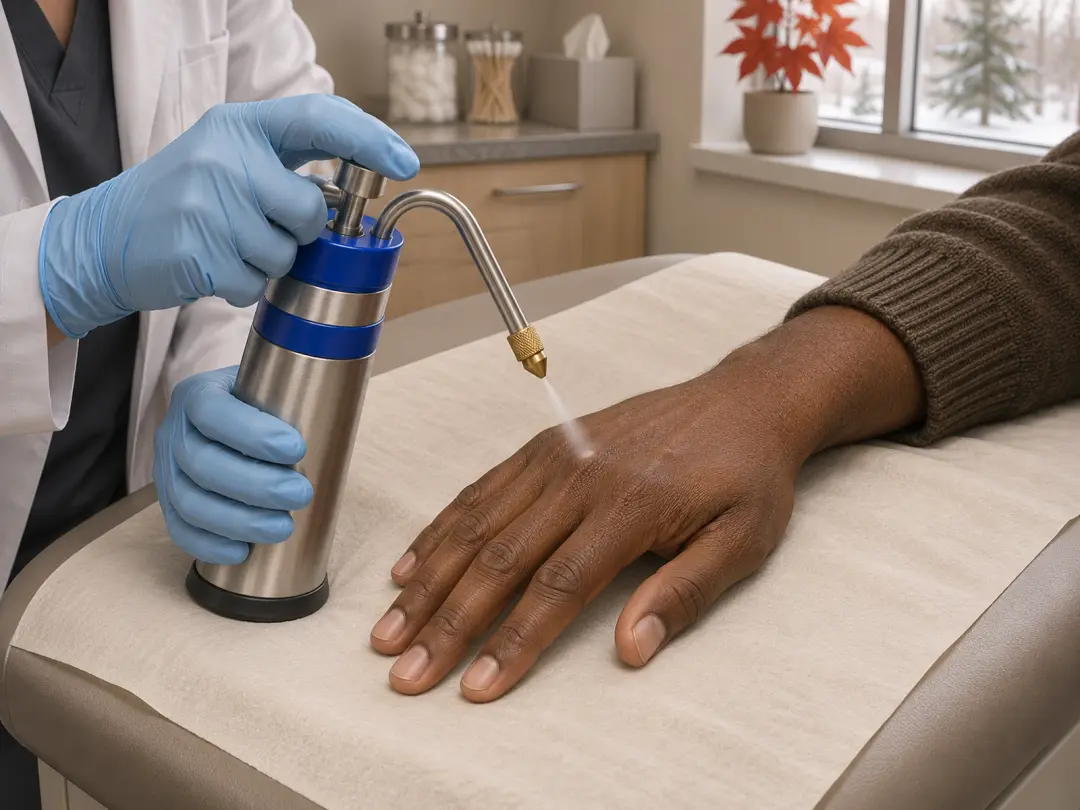
The liquid nitrogen is sprayed from a handheld device or applied with a probe or a cotton-tipped stick. The cold affects only the top layers of skin, which is why it is used for surface lesions.
Skin lesion cryotherapy is different from spa cryotherapy
Cold chambers and cold wands offered at gyms and spas are not medical treatments for skin lesions. This page is about the targeted freezing of a diagnosed lesion by a doctor.
What cryotherapy treats, and what it does not
All skin lesions are assessed by a doctor before treatment. The assessment combines clinical experience, dermoscopy and digital imaging, with AI-assisted analysis where appropriate. A biopsy is taken first when the diagnosis is not clear.
Actinic keratoses (sun-damage patches)
A mole, or any spot that could be a melanoma.
Seborrheic keratoses
A deep, thick or fast-growing lesion.
Skin tags
A lesion that has not been examined.
Warts
Morpheaform or high-risk basal cell carcinoma.
Selected superficial basal cell carcinoma and SCC in situ after biopsy
Large or returned skin cancers.
Some other small, benign surface growths
Lesions in places where a cold injury could affect function.
Why a mole is not frozen
Freezing destroys the tissue and leaves nothing for a lab to examine. If a spot could be a melanoma, it is assessed and, when needed, removed or biopsied so that it can be tested.
Tell the clinic if you have
- A condition triggered by cold, such as cold urticaria or Raynaud’s
- Poor circulation in the area
- A history of keloid or raised scars
- Darker skin, as freezing can lighten the treated spot
The visit and the procedure
- 1
Assessment
The lesion and the surrounding skin are examined. The treatment plan is explained and consent is given.
- 2
Preparation
The area is left uncovered. Local anesthetic is usually not needed.
- 3
Freezing
Liquid nitrogen is sprayed or applied for about 10 to 20 seconds, until the lesion turns white and a small rim of skin freezes. A second freeze may follow.
- 4
Thawing
The skin warms up. It turns red.
- 5
Aftercare
Written care instructions are given, and a recheck is booked if needed
What it feels like
The spray is very cold and can sting or burn sharply for a short time. The area may throb for a few minutes to hours. Freezing a larger or deeper lesion is more uncomfortable, and local anesthetic can be discussed in that case.
Freeze time
The time depends on the type, size and thickness of the lesion. A thin sun-damage patch needs a shorter freeze than a thick or wart-like lesion. Cancers are treated with longer, deeper freezing, and they are selected carefully.
Not sure this is the right treatment?
Every spot is assessed before anything is treated. If another option suits you better, Dr. Bastien will tell you.
Healing, blisters and aftercare
- 1
First hours
Redness and swelling. The area may throb.
What to do: Acetaminophen if needed. Do not rub the area.
- 2
24 hours
A blister may form. It can be clear or blood-tinged.
What to do: Leave it intact. Do not pop it unless told to.
- 3
Days 3 to 10
The blister dries into a crust
What to do: Keep it clean. Do not pick at it.
- 4
Weeks 1 to 3
The crust falls off and new skin shows beneath
What to do: Protect new skin from the sun
- 5
Weeks 3 to 6
The mark settles. Healing can take up to 6 weeks if swelling was marked, or on the lower legs.
What to do: Book a recheck if the lesion has not cleared
Aftercare
- The area can get wet. Pat it dry gently.
- Wash it with mild soap and water
- Use a bandage if it rubs on clothing, or if the blister is likely to break
- If a blister breaks, keep it clean and covered. Petroleum jelly may be advised.
- Avoid sun on the area and use sunscreen once it has healed
Call the clinic if
- Redness spreads, or the area becomes more painful after the second day
- Pus drains from the site, or you have a fever
- Bleeding does not stop with firm pressure
- A blister is very large or very painful
- The lesion has not cleared after the usual healing time
Risks, skin colour changes and repeat treatment
Lighter skin (hypopigmentation)
The most common. Pigment cells are more sensitive to cold than other skin cells. It is more noticeable in darker skin and can last months or be permanent.
Darker skin (hyperpigmentation)
Possible, and often fades.
Scar
A small white scar is possible, sometimes slightly below the skin surface.
Blister, crusting and weeping
Expected after treatment.
Infection
Uncommon.
Nerve effects
Numbness or tingling can occur near surface nerves. It is usually temporary.
Hair loss
Hair in the treated spot may not regrow.
Lesion not cleared
Some lesions need a second treatment.
Why repeat treatment happens
Freezing is controlled, so deeper cells may survive on the first pass. Thick lesions and warts often need repeat sessions, usually a few weeks apart. Lesions that persist, return or change are re-examined, and a biopsy may be taken.
Because no tissue is saved
Freezing gives no sample for the lab. This is why a diagnosis is made or confirmed before a suspected skin cancer is frozen.
Cryotherapy compared with other treatments, and home freezing kits
| Treatment | Main difference from cryotherapy |
|---|---|
| Curettage and electrodesiccation | Scrapes and heats the lesion. It leaves a round, pale scar, and it can be used for thicker lesions. |
| Surgical excision | Cuts out the lesion and sends it to the lab. It leaves a line scar and needs stitches. |
| Photodynamic therapy | Treats a whole area, using a cream and a lamp. It suits many sun-damage patches. |
| Prescription creams | Used at home over weeks, and treat an area rather than a spot |
| Laser removal | Used for selected benign lesions and vascular lesions. It is a different tool for a different group of lesions. |
The choice depends on what the lesion is, how thick it is, where it is and how you want it to heal. It is decided after assessment.
Home freezing kits
Over-the-counter freezing kits are available for warts. They are not as cold as the liquid nitrogen used in clinics, and they should not be used on a spot that has not been examined. A skin cancer, or a mole that is changing, can look like a wart or a harmless patch, and treating it at home can delay the diagnosis.
Cost and OHIP
When a lesion is treated for a medical reason, such as a sun-damage patch or a biopsy-confirmed skin cancer, the assessment and treatment are generally billed to OHIP. Cosmetic removal of harmless spots is usually not covered.
Related treatments
- Actinic Keratosis TreatmentTreatment of rough, scaly sun-damage patches with freezing, scraping, prescription creams or light therapy.
- Seborrheic Keratosis RemovalRemoval of seborrheic keratoses, the waxy, stuck-on growths, by freezing, scraping, shave removal or laser.
- Skin Tag RemovalRemoval of skin tags by snipping, freezing, heat or laser. Several tags can come off in one visit.
Frequently asked questions
Does cryotherapy hurt?
It stings or burns for a few seconds during freezing, and the area can throb afterward. Most people find it tolerable without anesthetic. Larger or deeper areas are more uncomfortable.
Will I get a blister?
Often, yes. A blister is part of normal healing. Leave it intact if you can, and keep the area clean. Contact the clinic if it is very large or painful.
How long until the area heals?
A crust usually falls off in 1 to 3 weeks. Full healing can take up to 6 weeks, and longer on the lower legs and hands. The skin colour may take months to settle.
Will cryotherapy leave a scar or a white mark?
A pale or darker mark is possible, and it is more noticeable on darker skin. A small scar is less common. The risk is discussed before treatment.
Can a mole be frozen?
No. A mole or any spot that could be a melanoma is not frozen, because freezing leaves no sample to examine. It is assessed first, and removed or biopsied if needed.
Can cryotherapy treat skin cancer?
It is used for selected early, thin and low-risk skin cancers, such as some superficial basal cell carcinomas and SCC in situ, after a biopsy confirms the diagnosis. Other cancers need surgery or another treatment.
Will I need more than one treatment?
Sometimes. Thick lesions and warts often need repeat sessions, a few weeks apart. A lesion that does not clear is re-examined.
Can I go to work or swim afterward?
Most people can return to normal activities at once. Avoid pools, lakes and hot tubs while a blister or open area is present, and protect the site from the sun.
Book a consultation
You don’t need a referral. Dr. Bastien examines the area first and tells you whether you need treatment.
1692 Murphy Rd, Sarnia
Monday to Friday, 8:30 am to 4:30 pm
Free parking on site