Benign Lesion Removal in Sarnia
Skin tags, rough "stuck-on" brown growths and small bumps are very common, and most are harmless. Many people still want them removed because they catch on clothing, get irritated or affect how they look.
At a glance
No referral needed.
Dr. David Bastien checks and removes benign skin lesions at 1692 Murphy Rd, Sarnia, for patients across Sarnia and Lambton County.
- Every growth is examined by a physician before removal
- Several lesions can often be removed in one visit
- Methods chosen to suit the area, including the face
- Tissue sent to a lab when anything looks unusual
What is benign lesion removal?
A lesion is any spot or growth on the skin that looks different from the skin around it. "Benign" means it is not cancer.
Benign lesion removal is a short in-office procedure that takes off a harmless growth. It is usually done with freezing, scraping, a small shave or a laser.
Benign lesions are very common, and most adults have several. They become more frequent with age and sun exposure.
Benign Lesion Removal: specific treatments
Common benign lesions we remove
Seborrheic keratosis
Also called: Senile wart, basal cell papilloma, "barnacle". What it looks like: Tan to black, warty, looks stuck on. Common places: Back, chest, face, scalp.
Stucco keratosis
Also called: Type of seborrheic keratosis. What it looks like: Small grey-white rough bumps. Common places: Ankles, feet, lower legs.
Skin tag
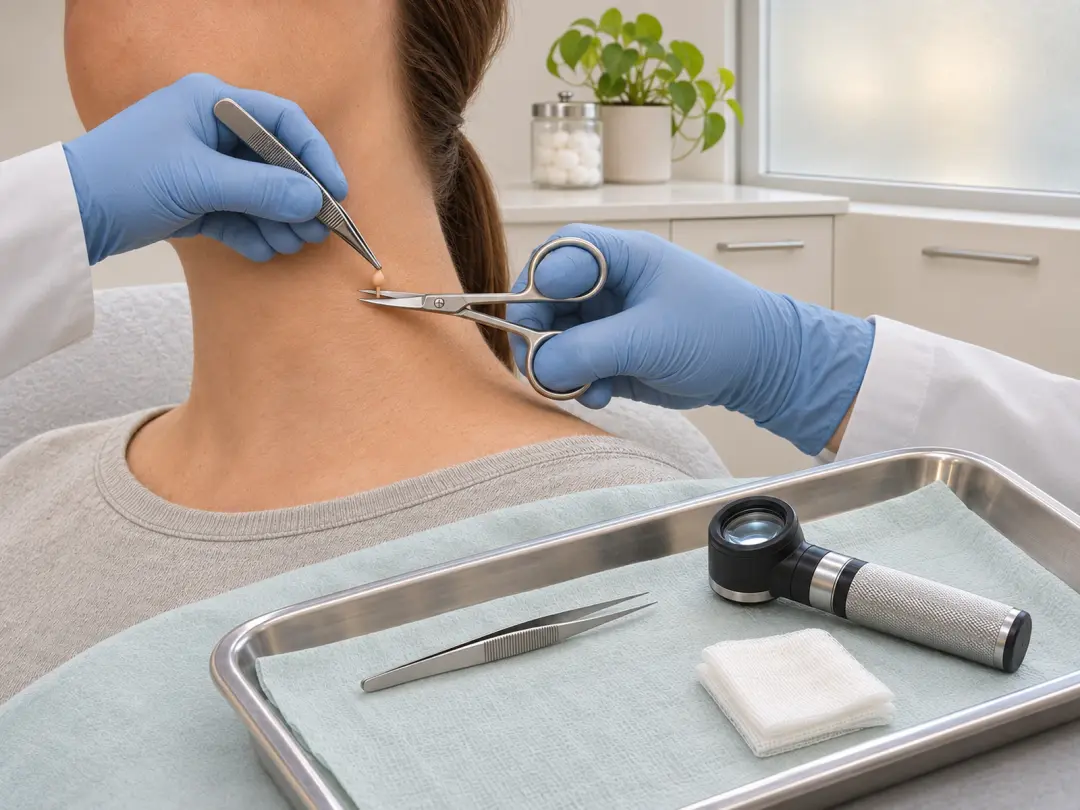
Also called: Acrochordon, fibroepithelial polyp. What it looks like: Soft, skin-coloured flap on a stalk. Common places: Neck, armpits, groin, eyelids.
Fibrous papule
Also called: —. What it looks like: Small firm skin-coloured dome. Common places: Nose.
Intradermal nevus
Also called: Raised benign mole. What it looks like: Soft, skin-coloured or light brown dome. Common places: Face, scalp.
Syringoma
Also called: Sweat duct growth. What it looks like: Tiny yellowish bumps. Common places: Under the eyes.
Dermatosis papulosa nigra
Also called: —. What it looks like: Small dark raised spots. Common places: Cheeks, around the eyes (darker skin).
Cysts and lipomas are lumps under the skin and are removed differently. See our cyst removal and lipoma removal pages.
Do benign lesions need to be removed?
No. A benign lesion does not need to be removed for health reasons. Removal is a choice.
People usually choose removal when a growth:
- Catches on jewellery, collars or a razor
- Bleeds, itches or becomes inflamed
- Sits on the face or another visible area
- Makes it hard to keep track of other spots
A growth should always be checked by a doctor if it changes quickly, bleeds without injury or looks different from your other spots.
Can a benign lesion turn into cancer?
Seborrheic keratoses and skin tags do not turn into cancer. Benign growths are not cancer, and most stay harmless for life.
The real risk is mistaking something else for a benign growth. Some skin cancers can look like a seborrheic keratosis or a mole.
That is why every lesion is examined before removal. If anything looks uncertain, the tissue is sent to a lab instead of being destroyed.
How benign skin lesions are removed
The method depends on the type of lesion, its size and where it is. Dr. Bastien will explain which suits your skin.
Cryotherapy (freezing)
How it works: Liquid nitrogen freezes the growth; it blisters and falls off
Best for: Thin seborrheic keratoses, small skin tags
Healing: 1 to 3 weeks
Snip removal
How it works: Skin tag is cut at its base after numbing
Best for: Skin tags of any size
Healing: About 1 week
Shave removal
How it works: Growth is shaved level with the skin
Best for: Raised moles, fibrous papules, thick keratoses
Healing: 1 to 2 weeks
Curettage
How it works: Growth is gently scraped off
Best for: Thicker seborrheic keratoses
Healing: About 1 week
Electrocautery
How it works: Heat seals and removes small growths
Best for: Small tags, dermatosis papulosa nigra
Healing: 1 to 2 weeks
Erbium YAG laser
How it works: Laser removes thin layers precisely
Best for: Facial lesions, syringomas, sensitive areas
Healing: 5 to 10 days
Excision
How it works: Full removal with stitches
Best for: Lesions that need a lab test
Healing: 1 to 2 weeks; stitches out in 5 to 14 days
Cryotherapy or laser? Freezing is quick and works well for small growths on the body, but can leave a pale mark on darker skin. Laser is more precise and often preferred on the face and for sensitive skin.
Shave or excision? A shave removes a raised growth and leaves a flat mark. An excision removes the full depth with stitches, and is used when a complete lab sample is needed.
What to expect at your visit
- 1
Check
Dr. Bastien examines each growth, often with a dermoscope.
- 2
Plan
You agree on which lesions to remove, the method and the cost.
- 3
Numbing
A small injection or numbing cream is used for snip, shave and laser removal.
- 4
Removal
Most lesions take a few minutes each.
- 5
Dressing
The area is covered and you get written aftercare instructions.
Most visits take 20 to 30 minutes. Up to 10 small lesions can usually be removed in one visit.
Not sure this is the right treatment?
Every spot is assessed before anything is treated. If another option suits you better, Dr. Bastien will tell you.
Recovery and aftercare
- 1
Day 1
Mild redness and tenderness
- 2
Days 2 to 7
A scab or blister forms (after freezing)
- 3
Weeks 1 to 3
The scab falls off; the skin underneath is pink
- 4
Months 1 to 3
Pinkness fades to a flat mark
- Keep the area clean and dry for 24 hours
- Apply petroleum jelly daily until healed
- Do not pick scabs
- Use SPF 30 or higher on the area for 3 months to prevent dark marks
- Call us if you see spreading redness, pus or a fever
Scarring, side effects and recurrence
Most removals heal with a small flat mark that fades over a few months. The risk of a noticeable scar depends on the method, the area and how your skin heals.
Pink mark that fades
Common.
Lighter or darker patch
Possible, more common on darker skin.
Infection
Uncommon.
Raised or thick scar
Rare; higher risk on the chest and shoulders.
A removed growth rarely returns at the same spot. New seborrheic keratoses and skin tags can still form elsewhere over time.
Why not remove it at home?
Skin tag bands, freezing kits and online creams are sold for home use, including for fibrous papules and "senile warts". We do not recommend them.
- The growth may not be what you think it is
- Cutting or tying can cause bleeding and infection
- Acids and creams can burn the skin and leave scars
- Nothing is sent to a lab if it turns out to be abnormal
This matters most on the face and nose, where a scar is easy to see.
Cost and OHIP coverage
In Ontario, removing a harmless growth for appearance or comfort is a cosmetic, uninsured service. OHIP does not cover it.
If a lesion looks suspicious, the assessment and any biopsy are medically necessary and covered by OHIP.
Frequently asked questions
What is benign lesion removal?
It is a short in-office procedure to remove a harmless skin growth, such as a skin tag or seborrheic keratosis. It is usually done with freezing, a small shave, scraping or laser.
Should benign lesions be removed?
Only if you want them removed. There is no medical need, but removal helps when a growth is irritated, bleeds, catches on clothing or bothers you.
Is benign lesion removal covered by OHIP or insurance?
Cosmetic removal is not covered by OHIP. If a lesion looks suspicious, the assessment and biopsy are covered. Some private plans pay part of cosmetic removal.
Does it hurt?
Freezing stings for a few seconds. For snip, shave and laser removal, the skin is numbed first, so most people feel only a small pinch from the injection.
Will removal leave a scar?
Most removals leave a small flat mark that fades over a few months. A visible scar is uncommon, but no method can promise no mark at all.
How long is the recovery time?
Most areas heal in 1 to 2 weeks. Freezing can take up to 3 weeks. You can usually return to work the same day.
Can I remove a skin tag or fibrous papule at home?
We do not recommend it. Home removal can cause bleeding, infection and scarring, and the growth may not be what it seems. A quick in-office removal is safer.
Serving Sarnia and Lambton County
Our clinic is at 1692 Murphy Rd, Sarnia, with free on-site parking. We welcome patients from Sarnia, Point Edward, Bright's Grove, Corunna, Petrolia, Forest and across Lambton County.
Book a removal consultation. Call the clinic or book online. Hours: Monday to Friday, 8:30 am to 4:30 pm.
Related: Skin cancer assessment · Vascular laser treatment
Book a consultation
You don’t need a referral. Dr. Bastien examines the area first and tells you whether you need treatment.
1692 Murphy Rd, Sarnia
Monday to Friday, 8:30 am to 4:30 pm
Free parking on site