Advanced Laser Treatments in Sarnia, Ontario
Many people come in after trying creams and treatments that did not help. A red patch that never fades, a bump that keeps catching on a razor, or a scar that still bothers them years later.
At a glance
- Healing
- About 7 days
- Anaesthetic
- Numbing cream
- OHIP
- Private fee
No. Cosmetic laser treatment is not covered.
No referral needed.
Lasers are not one treatment. Each laser uses a specific type of light for a specific job, so the right choice depends on what is on your skin.
At Dr. Bastien Mole Clinic, two medical lasers are used, each chosen after your skin has been examined.
Assessment before treatment. Every skin lesion is assessed before any laser treatment. The assessment combines Dr. Bastien's clinical experience and dermatology training with dermoscopy, digital imaging and AI-assisted analysis where appropriate. A spot that could be a skin cancer is never lasered without being checked first.
Erbium:YAG laser
Precise resurfacing for scars, texture and selected benign growths
QuadroStar Pro Yellow laser
Yellow light for redness, broken blood vessels and vascular spots
Physician-led
Dr. Bastien assesses every spot and plans every treatment
Quick answers
What can lasers treat here?
Redness, broken vessels, red spots, acne and surgical scars, and selected benign growths
Does it hurt?
Most people feel warmth or a snap. Numbing cream is used when needed.
How many sessions?
1 to 3 for many spots, 3 to 5 for scars and redness
Downtime?
From none to about 7 days, depending on the laser
Is it covered by OHIP?
No. Cosmetic laser treatment is not covered.
Do I need a referral?
No
What is an advanced laser treatment?
A medical laser sends a beam of light at one exact wavelength. Different parts of the skin absorb different wavelengths, so a laser can target water, blood or pigment while leaving nearby skin largely untouched.
"Advanced" usually means the laser is precise enough to treat a small target with controlled depth, less heat damage and faster healing than older devices.
Ablative (such as Erbium:YAG)
What it targets: Water in the skin surface. Typical uses: Resurfacing scars, smoothing texture, removing raised growths.
Vascular (such as yellow light)
What it targets: Red blood in small vessels. Typical uses: Redness, broken capillaries, red spots.
Pigment and tattoo lasers
What it targets: Dark pigment or ink. Typical uses: Brown spots, tattoos (not offered at this clinic).
Hair removal lasers
What it targets: Pigment in hair follicles. Typical uses: Unwanted hair (not offered at this clinic).
Advanced Laser Treatments: specific treatments
The Erbium:YAG laser
The Erbium:YAG laser is absorbed by water in the skin. It removes very thin layers of tissue with fine control, often only a fraction of a millimetre at a time.
Because it produces less heat than many other resurfacing lasers, the surrounding skin usually heals faster, with a lower risk of lasting colour change.
What it is used for
- Acne scars and uneven texture
- Depressed or raised surgical scars
- Selected benign growths, such as seborrheic keratoses, skin tags and some raised bumps
- Scar revision, to blend scar edges into nearby skin
The QuadroStar Pro Yellow laser
The QuadroStar Pro Yellow laser uses yellow light at 577 nm, a wavelength strongly absorbed by blood. It heats tiny vessels so the body can clear them, while the skin surface stays intact.
Treatment is gentle, and most people return to normal activities the same day.
What it is used for
- Facial redness, including rosacea-associated redness
- Broken capillaries on the face and nose
- Cherry angiomas and small hemangiomas
- Venous lakes on the lips and ears
- Red or pink scars, including red marks left by acne
Which laser for which concern?
Acne scars
Usual laser: Erbium:YAG, plus yellow laser for redness. Typical sessions: 3 to 5.
Surgical scars
Usual laser: Yellow laser for red scars, Erbium:YAG for texture. Typical sessions: 3 to 5.
Rosacea redness and broken capillaries
Usual laser: QuadroStar Pro Yellow. Typical sessions: 2 to 4.
Cherry angiomas and venous lakes
Usual laser: QuadroStar Pro Yellow. Typical sessions: 1 to 2.
Seborrheic keratoses and skin tags
Usual laser: Erbium:YAG. Typical sessions: 1.
Many people have more than one concern. Your plan may combine both lasers over several visits.
What lasers here do not treat: moles that need assessment, suspected skin cancers, tattoos, melasma and hair removal. A suspicious mole is examined and, if needed, removed surgically so it can be tested in a lab.
What happens at a laser visit
- 1
Assessment
Dr. Bastien examines the spot or area, often with dermoscopy, and confirms a laser is suitable
- 2
Plan
Which laser, how many sessions, expected results and cost
- 3
Preparation
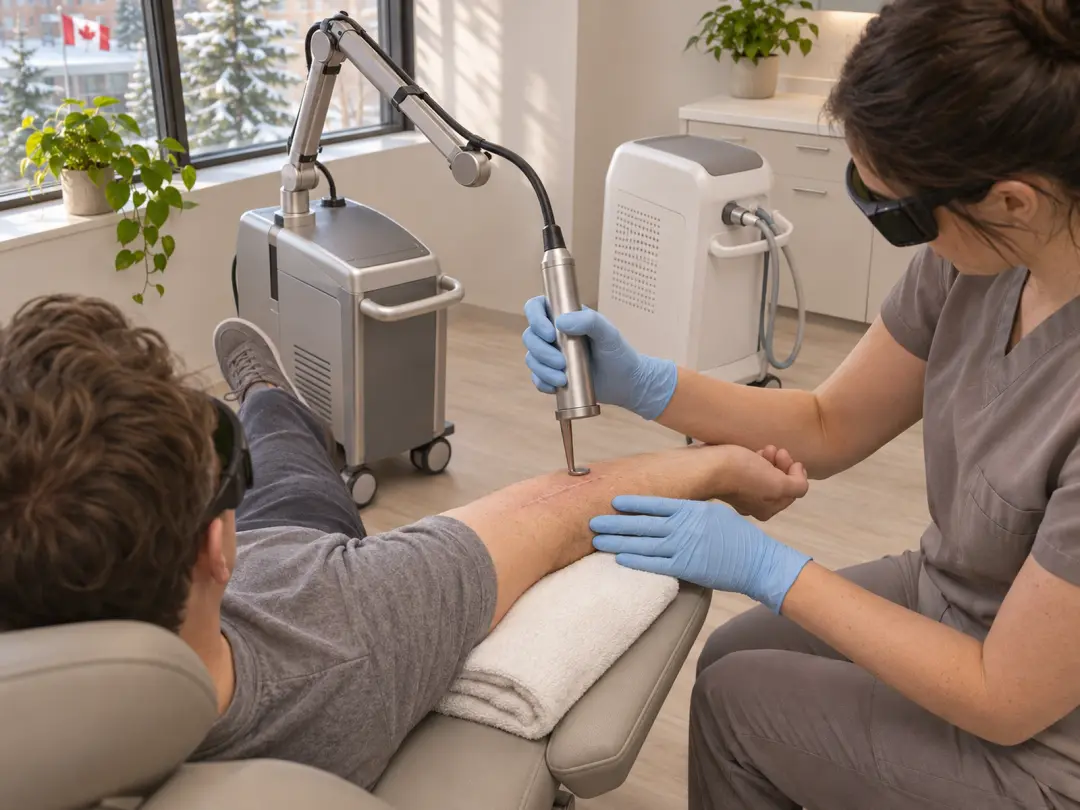
Skin is cleansed. Numbing cream is applied for resurfacing. Eye protection is worn.
- 4
Treatment
Usually 10 to 30 minutes, depending on the area
- 5
Aftercare
Written instructions, and a follow-up date if more sessions are needed
Not sure this is the right treatment?
Every spot is assessed before anything is treated. If another option suits you better, Dr. Bastien will tell you.
Recovery and side effects
Recovery depends on which laser is used.
| QuadroStar Pro Yellow | Erbium:YAG | |
|---|---|---|
| Right after | Mild redness, sometimes slight swelling | Redness and a sunburn-like feeling |
| Next few days | Small spots may darken or crust briefly | Flaking or light crusting |
| Back to normal routine | Usually the same day | Usually after 5 to 7 days |
Possible side effects
- Temporary redness, swelling or bruising
- Temporary darkening or lightening of the skin, more likely in darker skin
- Crusting, and rarely infection or scarring
These risks are lowered by careful settings, a proper skin assessment and good aftercare.
Before your treatment
- Avoid sun and tanning, including self-tanner, for 2 to 4 weeks
- Stop retinoids and exfoliating acids about 1 week before resurfacing
- Tell Dr. Bastien about any medicines, including blood thinners and isotretinoin (Accutane)
- Tell him if you get cold sores. Preventive medicine may be advised before facial resurfacing.
- Come with clean skin and no makeup on the area
Who may need to wait
- People who are pregnant or breastfeeding
- People with active infection or open sores in the area
- People who took isotretinoin in the past 6 to 12 months
- People with a fresh tan or sunburn
Choosing a laser clinic in Sarnia
Laser is a medical treatment, and results depend on the right diagnosis as much as the device. Questions worth asking any clinic:
- Who examines my skin before treatment, and what is their training?
- What exactly is this spot, and could it be something that needs testing?
- Which laser will be used, and why is it suitable for my skin type?
- How many sessions should I expect, and what results are realistic?
- What does the full course cost, and what if I need more sessions?
Cost of laser treatment in Sarnia
Laser treatment for cosmetic concerns is not covered by OHIP. Costs depend on the laser, area size and number of sessions.
Frequently asked questions
What is the difference between the two lasers?
Erbium:YAG removes thin layers of skin to smooth scars and remove raised growths. QuadroStar Pro Yellow targets blood vessels to reduce redness and red spots, without breaking the skin.
Do laser treatments hurt?
Most people feel warmth or a quick snap, like a rubber band. Numbing cream is used for resurfacing.
How often should laser treatments be done?
Sessions are usually spaced 4 to 6 weeks apart so the skin can heal and respond between treatments.
Are laser results permanent?
Treated scars and removed growths usually stay improved. Redness and new spots can return over time, especially with rosacea, so touch-up sessions may help.
Can lasers be used on darker skin?
Often yes, with adjusted settings. Darker skin has a higher risk of temporary colour change, so a test area may be suggested.
What should I avoid before laser treatment?
Avoid sun exposure, tanning and self-tanner for 2 to 4 weeks, and stop retinoids about a week before resurfacing.
Can a laser remove a mole?
A mole is assessed first. A mole that needs removing is usually removed surgically so it can be tested in a lab, rather than destroyed by laser.
Do I need a referral?
No. You can book an assessment directly at 1692 Murphy Rd, Sarnia, by calling 1-866-550-MOLE (6653).
Book a consultation
You don’t need a referral. Dr. Bastien examines the area first and tells you whether you need treatment.
1692 Murphy Rd, Sarnia
Monday to Friday, 8:30 am to 4:30 pm
Free parking on site