Actinic Keratosis Treatment in Sarnia, Ontario
An actinic keratosis (AK) is a rough, scaly patch caused by years of sun exposure.
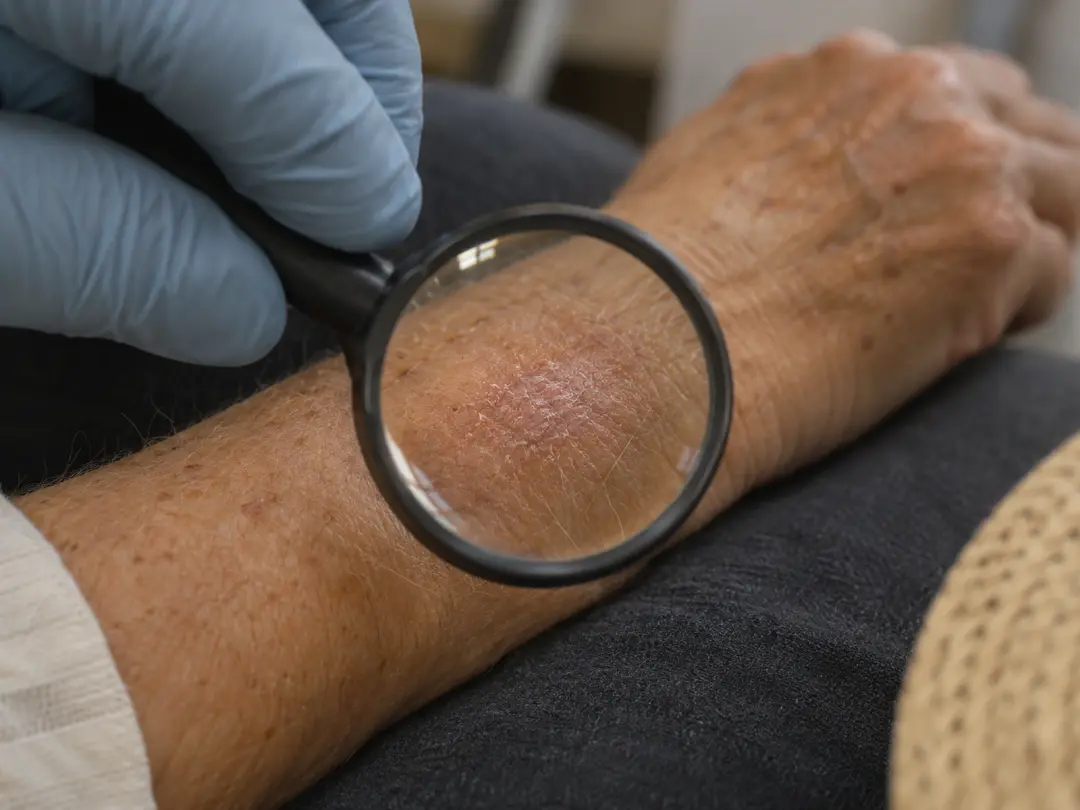
At a glance
- OHIP
- OHIP may cover
Often, when treated for a medical reason
No referral needed.
It is not a skin cancer, but it is a sign of sun damage, and a small share can turn into squamous cell carcinoma. AKs are checked and, in most cases, treated.
Common
AKs become more frequent with age and with a history of sun exposure
On sun-exposed skin
Face, scalp, ears, lips, forearms and the backs of the hands
Checked first
The spot is examined, and a biopsy is taken if it looks unusual
Treated in clinic
Freezing, light treatment, scraping and prescribed creams
Often more than one
The whole sun-damaged area may be treated
Quick answers
Is an AK a skin cancer?
No. It is a pre-cancer. A few can progress to squamous cell carcinoma.
Which ones will turn into cancer?
That cannot be predicted, which is why they are treated
What is the usual treatment?
Freezing (cryotherapy) for single spots. Creams or light treatment for larger areas.
Will it leave a mark?
Often a pale or darker mark, which is usually small. Scarring is less common.
Can AKs come back?
Yes. New ones can appear as sun damage continues to show.
Is it covered by OHIP?
Often, when treated for a medical reason
What is an actinic keratosis?
An AK is a patch of skin cells that were damaged by ultraviolet (UV) light and now grow abnormally. It is sometimes called a sun spot or solar keratosis. The change is limited to the top layer of skin.
A single AK can stay the same, clear up on its own or progress to squamous cell carcinoma (SCC). Estimates of how often one AK progresses vary widely in the medical literature, mostly from less than 1% to about 10%. Cleared AKs can also return.
Who gets actinic keratoses
- People with fair skin who burn easily
- People with years of sun exposure, including outdoor work and sports
- People who have used tanning beds
- Older adults
- People with a weakened immune system
- People who have had skin cancer before
Why they matter
Having AKs means the skin has had a lot of sun damage. Areas of damaged skin can contain several AKs and early cancers that are not easy to see, so the whole area is examined.
AKs on the lower lip are called actinic cheilitis. They are a higher-risk place and are checked with care.
What does an actinic keratosis look and feel like?
AKs are often easier to feel than to see. A typical one feels rough, like fine sandpaper.
Colour
Pink, red, tan, brown or skin-coloured.
Surface
Dry, scaly or crusty. The scale can flake off and come back.
Size
From a few millimetres to a few centimetres. Several can join.
Sensation
Often none. Some itch, sting, burn or feel tender.
Place
Face, ears, scalp, lips, neck, forearms, backs of hands.
Thick type
A hard, wart-like growth, sometimes a horn-shaped growth.
Book a check promptly if an AK
- Grows quickly, becomes thick or turns into a lump
- Is tender, painful or bleeds
- Forms an open sore that does not heal
- Is on the lip, or the lip is scaly and cracked for weeks
These signs can mean an early skin cancer, which is checked with a biopsy.
Is it an actinic keratosis or something else?
A seborrheic keratosis (SK) is a harmless, waxy, stuck-on growth that can appear anywhere, including skin that is not exposed to sun. An AK has a rough, gritty scale and appears on sun-exposed skin. Eczema, psoriasis and warts can also look similar, so a spot that persists should be examined.
How an actinic keratosis is assessed
All skin lesions are assessed by a doctor before treatment. The assessment combines clinical experience, dermoscopy and digital imaging. AI-assisted analysis is used where appropriate, alongside the doctor's own judgement.
- 1
History
How long the patches have been there, changes, past skin cancers, and sun history
- 2
Examination
The face, scalp, ears, hands and arms are checked, with the skin felt as well as seen
- 3
Dermoscopy
A lit magnifier shows patterns that help separate AK from other lesions
- 4
Biopsy, when needed
A small sample is taken from a spot that is thick, tender, bleeding, growing fast or does not respond to treatment
- 5
Plan
Options are explained, and a treatment is chosen for the spot or the whole area
Most AKs are diagnosed by looking and feeling, so a biopsy is not needed for every patch. A whole-body check with photos can help track new or changing spots over time.
Not sure this is the right treatment?
Every spot is assessed before anything is treated. If another option suits you better, Dr. Bastien will tell you.
Treatment options for actinic keratosis
Treatments fall into two groups. Lesion-directed treatments act on single spots. Field-directed treatments cover a whole area of sun-damaged skin, including spots that are too small to see.
Cryotherapy (liquid nitrogen)
Type: Single spot
Usually considered for: A few isolated AKs
Points to know: The most common treatment. Quick. Blister and crust. A pale or dark mark is possible.
Curettage
Type: Single spot
Usually considered for: Thick or stubborn AKs
Points to know: Scraped under local anesthetic. A small open wound.
Photodynamic therapy (PDT)
Type: Field
Usually considered for: Many AKs on the face or scalp
Points to know: A light-sensitising cream and a lamp. Red, sore skin for several days.
Prescribed creams (for example fluorouracil or imiquimod)
Type: Field
Usually considered for: Several AKs in one area
Points to know: Used at home for days to weeks. Red, crusted skin during treatment.
Surgical removal or biopsy
Type: Single spot
Usually considered for: A thick, tender or suspicious AK, or a horn
Points to know: Gives a sample for the lab
Combining freezing of visible spots with treatment of the surrounding area has been reported to clear more AKs, and for longer, than freezing alone. The doctor explains which approach suits you.
Spot treatment or whole-area treatment: how the choice is made
| Your situation | A common approach |
|---|---|
| One to a few separate AKs | Freezing, with a follow-up check |
| Many AKs close together on the face or scalp | Field treatment with PDT or a cream, with freezing for thick spots |
| A thick or tender AK, or one that returns | Biopsy or scraping, to check for early cancer |
| AK on the lip | Examined with care. Treatment is tailored to the place. |
| Repeated AKs after past treatment | Field treatment and closer follow-up |
What to expect with each
Freezing
About 10 to 20 seconds per spot, and a second freeze may follow. It stings or burns during treatment. The spot turns red, may blister, then forms a crust that falls off in 1 to 3 weeks.
PDT
A cream is applied and left on for a set time, then the area is lit for several minutes. A burning or stinging feeling is common during the lighting. The skin is red, swollen and crusted for several days, and sun must be avoided for about 48 hours. It has its own page.
Creams
Used as prescribed. The skin gets red, sore and crusted before it settles. Follow the instructions and call the clinic if the reaction is severe.
Scraping
Local anesthetic is used. The wound heals in 2 to 4 weeks.
Any spot that does not clear, or that looks more concerning, is re-examined and may need a biopsy.
Recovery and aftercare
Freezing
Redness and swelling in hours. A blister may form in 24 hours. The crust falls off in 1 to 3 weeks. Full healing may take longer on the lower legs and hands.
Scraping
An open wound. Scab for 2 to 4 weeks.
PDT
Redness, swelling and crusting for about 1 week. Settles over 2 to 4 weeks.
Creams
Redness and crusting during the course. Settles 2 to 4 weeks after finishing.
Aftercare
- Wash gently and pat dry
- Leave blisters alone, or follow the clinic’s instructions if one is large or painful
- Do not pick at crusts
- Use acetaminophen for soreness, unless told otherwise
- Keep treated skin out of the sun and use sunscreen once it has healed
- Call the clinic for spreading redness, pus, fever or a spot that does not heal
The skin may look paler or darker for several months. Pigment changes are more likely with freezing and are usually small.
Recurrence, follow-up and sun protection
AKs can come back, and new ones appear where the skin is sun-damaged. A follow-up visit is usually booked a few weeks to months after treatment to check that spots have cleared.
Follow-up
- A recheck of treated areas
- Regular skin checks. The interval depends on how many AKs you have had and on any history of skin cancer.
- Biopsy of any spot that stays, grows or becomes tender
- Whole-body photos and mole mapping to track new or changing spots
Sun protection, including near Lake Huron and the St. Clair River
Sarnia summers on the water bring strong UV, and the water and sand reflect it. Sun damage adds up over many years.
- Use broad-spectrum sunscreen of SPF 30 or higher on exposed skin, and reapply it every 2 hours and after swimming
- Wear a wide-brimmed hat, sunglasses and long sleeves
- Seek shade around midday
- Protect lips with an SPF lip balm
- Avoid tanning beds
- Outdoor workers should protect ears, neck and the backs of the hands too
Cost and OHIP
Treatment of actinic keratoses is often billed to OHIP when it is done for a medical reason. Coverage can differ by treatment, so the clinic confirms what applies before you agree to anything.
Related treatments
- Photodynamic Therapy (PDT)A light-activated cream that treats many sun-damage patches on the face or scalp in one session.
- CryotherapyFreezing with liquid nitrogen for sun-damage patches, seborrheic keratoses, skin tags and selected early skin cancers.
- Curettage and ElectrodesiccationScraping and heat for small, low-risk skin cancers and some harmless growths. The wound heals without stitches.
Frequently asked questions
Is an actinic keratosis a skin cancer?
No. It is a pre-cancer. A small share can progress to squamous cell carcinoma, and a doctor cannot tell which ones, so AKs are checked and usually treated.
Can I leave an actinic keratosis alone?
Some AKs stay the same or clear up, and some return or progress. Because the outcome cannot be predicted, an examination is advised, and treatment is usually offered. You decide with the doctor after the options are explained.
What is the difference between an AK and a seborrheic keratosis?
An AK is rough, scaly and caused by sun damage. A seborrheic keratosis is a harmless, waxy, stuck-on growth that can appear on any skin. An examination tells them apart.
Does freezing hurt?
It stings or burns for the few seconds of treatment, and the area may throb for a short time afterward. Most people manage it without anesthetic. Acetaminophen helps if the area is sore.
What is the difference between freezing and PDT?
Freezing treats single visible spots. PDT treats a whole area, including spots that are too small to see, and is used when there are many AKs. PDT causes several days of red, sore skin.
Can I use over-the-counter creams?
Over-the-counter products do not treat AKs. Prescription creams are used under a doctor's guidance. Do not use freezing kits or creams on a spot that has not been examined.
How do I stop getting new ones?
Sun protection is the main step: sunscreen, a hat, shade and no tanning beds. Regular skin checks and early treatment of new patches help too.
Do I need a referral to book?
No. You can book an assessment directly.
Book a consultation
You don’t need a referral. Dr. Bastien examines the area first and tells you whether you need treatment.
1692 Murphy Rd, Sarnia
Monday to Friday, 8:30 am to 4:30 pm
Free parking on site