Acne Scar Treatment in Sarnia, Ontario
Acne scars are marks or dents left after acne heals. Most can be improved with treatment, though few disappear completely.
At a glance
- Healing
- About 5 to 7 days
- OHIP
- Private fee
No. Acne scar treatment is cosmetic.
No referral needed.
At Dr. Bastien Mole Clinic, your skin is assessed first. The plan then depends on your scar type, skin type and goals.
Assessment before treatment. Every skin concern is assessed before any treatment. The assessment combines Dr. Bastien's clinical experience and dermatology training with dermoscopy and digital imaging where appropriate.
Physician-led
Every plan is made by Dr. Bastien after examining your skin
Laser options
Erbium:YAG laser resurfacing for textured scars, and QuadroStar Pro Yellow for lingering redness
Realistic goals
The aim is smoother, more even skin, not perfect skin
Quick answers
Can acne scars be removed 100%?
Usually not. Most improve by about 50 to 80% with a series of treatments.
How many sessions?
Usually 3 to 5, about 4 to 6 weeks apart
Downtime?
About 5 to 7 days of redness and flaking after laser resurfacing
When do I see results?
Gradually over 3 to 6 months as new collagen forms
Is it covered by OHIP?
No. Acne scar treatment is cosmetic.
Do I need a referral?
No
What causes acne scars?
Deep, inflamed acne damages the skin's collagen. As it heals, the skin may make too little collagen, which leaves a dent, or too much, which leaves a raised scar.
Scarring is more likely with cystic or nodular acne, with picking or squeezing, and when acne goes untreated for a long time. Genetics also play a part.
Acne scars or acne marks?
Many "scars" are actually marks, and they are treated differently.
| Acne marks | Acne scars | |
|---|---|---|
| What they are | Flat red, pink or brown spots | A change in skin texture: dents or bumps |
| Feel | Smooth to the touch | Pitted or raised |
| Go away on their own? | Often fade over 3 to 12 months | Usually do not go away on their own |
| Main treatment | Sun protection, topicals, vascular laser for redness | Resurfacing laser and other procedures |
Types of acne scars
Knowing your scar type matters, because each responds best to a different treatment.
Rolling
What it looks like: Wide, soft dips with sloping edges, giving a wavy look. Usual response: Responds well to resurfacing, sometimes with subcision.
Boxcar
What it looks like: Round or oval dents with sharp edges. Usual response: Shallow ones respond well to resurfacing.
Ice pick
What it looks like: Narrow, deep pits, like large pores. Usual response: The hardest to treat. May need targeted spot treatment plus resurfacing.
Hypertrophic or keloid
What it looks like: Raised, firm scars, more common on the chest, back and jaw. Usual response: Treated with injections, silicone or laser, not resurfacing alone.
Most people have a mix of types, so a combined plan is common.
Treatment options for acne scars
No single treatment suits every scar. After your assessment, Dr. Bastien explains which options fit your skin.
Erbium:YAG laser resurfacing
Best for: Rolling and boxcar scars, uneven texture
How it works: Removes thin layers of skin and triggers new collagen
QuadroStar Pro Yellow laser
Best for: Red or pink marks after acne
How it works: Targets small blood vessels that cause redness
Subcision
Best for: Tethered rolling scars
How it works: A needle releases bands pulling the skin down
Spot treatment (such as TCA CROSS)
Best for: Ice pick scars
How it works: A strong acid applied inside the pit rebuilds it from the base
Steroid injections
Best for: Raised or keloid scars
How it works: Flatten and soften the scar
Topical retinoids and sunscreen
Best for: Marks and very mild texture
How it works: Support skin renewal and stop marks darkening
Treatment options offered in clinic may vary. Dr. Bastien will explain what is available for your scars at your visit.
Active acne comes first. Scars are treated once acne is under control. Treating scars during active breakouts gives poorer results, and new breakouts can form new scars.
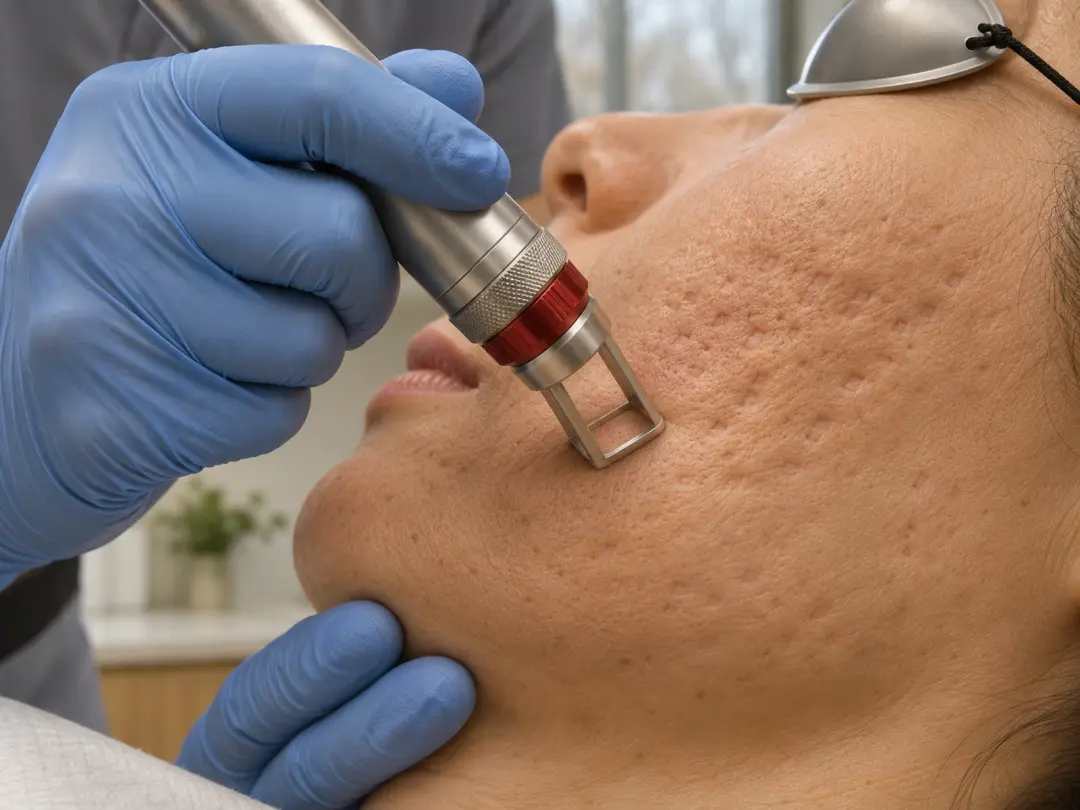
How Erbium:YAG laser works on acne scars
The Erbium:YAG laser removes very thin layers of skin with precise control. This softens the edges of scars and evens out texture.
The controlled injury also prompts the skin to build new collagen. Collagen keeps forming for months, so results improve slowly after each session.
Fractional settings treat tiny columns of skin and leave the skin between them intact. This means faster healing than older full-surface resurfacing.
What happens during treatment
- 1
Assessment
Dr. Bastien examines your scars, skin type and acne history, and sets realistic goals
- 2
Preparation
Skin is cleansed and a numbing cream is applied for about 30 to 45 minutes
- 3
Laser treatment
The laser is passed over the area. Most people feel heat or prickling.
- 4
Aftercare
A soothing ointment is applied and you receive written care instructions
A face treatment usually takes about 20 to 30 minutes, plus numbing time.
Not sure this is the right treatment?
Every spot is assessed before anything is treated. If another option suits you better, Dr. Bastien will tell you.
Recovery and aftercare
Recovery depends on how deep the treatment goes.
- 1
Days 1 to 3
Redness, swelling and a sunburn-like feeling
- 2
Days 3 to 7
Flaking or light crusting as the skin renews
- 3
Weeks 1 to 4
Pinkness fades. Makeup can usually be used after about a week.
- 4
Months 1 to 6
Collagen keeps building and texture keeps improving
Aftercare tips
- Keep the skin moist with the ointment you are given
- Do not pick or peel flaking skin
- Use broad-spectrum SPF 30 or higher every day
- Avoid sun, hot tubs and heavy exercise for a few days
- Skip retinoids and exfoliants until your skin has healed
How many sessions will I need?
Most people need 3 to 5 sessions, spaced about 4 to 6 weeks apart. Deeper or mixed scars may need more, or a combination of treatments.
Each session builds on the last. Final results are usually judged about 6 months after the last session.
Results: what to expect
Acne scars can be improved, but they rarely vanish completely. Most people see a clear improvement in texture and depth.
- Rolling and shallow boxcar scars usually respond best
- Ice pick and deep boxcar scars are harder to treat and may need combined methods
- Results are long-lasting, though skin keeps aging naturally
- New acne can cause new scars, so keeping acne controlled protects your results
Results vary from person to person.
Is acne scar treatment safe for darker skin?
Laser treatment can be used on many skin types, but darker skin has a higher risk of temporary dark patches after treatment.
Settings are adjusted for your skin type. Some people are advised to use a skin-lightening cream for a few weeks before treatment, and strict sun protection after.
Who should wait or avoid treatment?
Treatment may be delayed or another option suggested if you:
- Have active acne or a current skin infection, including cold sores
- Have taken isotretinoin (Accutane) in the past 6 to 12 months
- Are pregnant or breastfeeding
- Have a recent tan or sunburn
- Tend to form keloid scars
Tell Dr. Bastien about your medicines and history at your assessment.
Cost of acne scar treatment in Sarnia
Acne scar treatment is cosmetic, so it is not covered by OHIP. Private insurance plans rarely cover it.
Related treatments
- Surgical Scar TreatmentYellow laser, Erbium resurfacing, injections or revision to make a surgical scar flatter and less red.
- Erbium YAG LaserA resurfacing laser that removes thin layers of skin. Dr. Bastien uses it for scars and small harmless growths.
- QuadroStar Pro Yellow LaserA 577 nm laser for redness, broken capillaries, red spots and venous lakes, usually with no downtime.
Frequently asked questions
Can acne scars go away on their own?
Red or brown marks often fade over months. True scars, which change the skin's texture, usually do not go away without treatment.
What is the best treatment for acne scars?
There is no single best treatment. The right choice depends on your scar type, skin type and goals, which is why an assessment comes first.
Is acne scar treatment permanent?
The improvement is long-lasting, because the treated skin is rebuilt with new collagen. New acne can still cause new scars.
Does laser treatment for acne scars hurt?
Numbing cream is used, so most people feel heat or prickling rather than pain. The skin feels like a sunburn for a day or two afterwards.
What is the hardest acne scar to treat?
Ice pick scars are usually the hardest, because they are narrow and deep. They often need targeted spot treatment along with resurfacing.
Can I have treatment after Accutane?
Yes, but usually not right away. Laser resurfacing is often delayed for 6 to 12 months after isotretinoin. Dr. Bastien will advise on timing.
Can I get acne scar treatment while pregnant?
Laser treatment and many scar creams are usually postponed during pregnancy and breastfeeding. Gentle skin care and sun protection are generally fine.
Do I need a referral to book?
No. You can book an assessment directly at the clinic at 1692 Murphy Rd, Sarnia, by calling 1-866-550-MOLE (6653).
Book a consultation
You don’t need a referral. Dr. Bastien examines the area first and tells you whether you need treatment.
1692 Murphy Rd, Sarnia
Monday to Friday, 8:30 am to 4:30 pm
Free parking on site